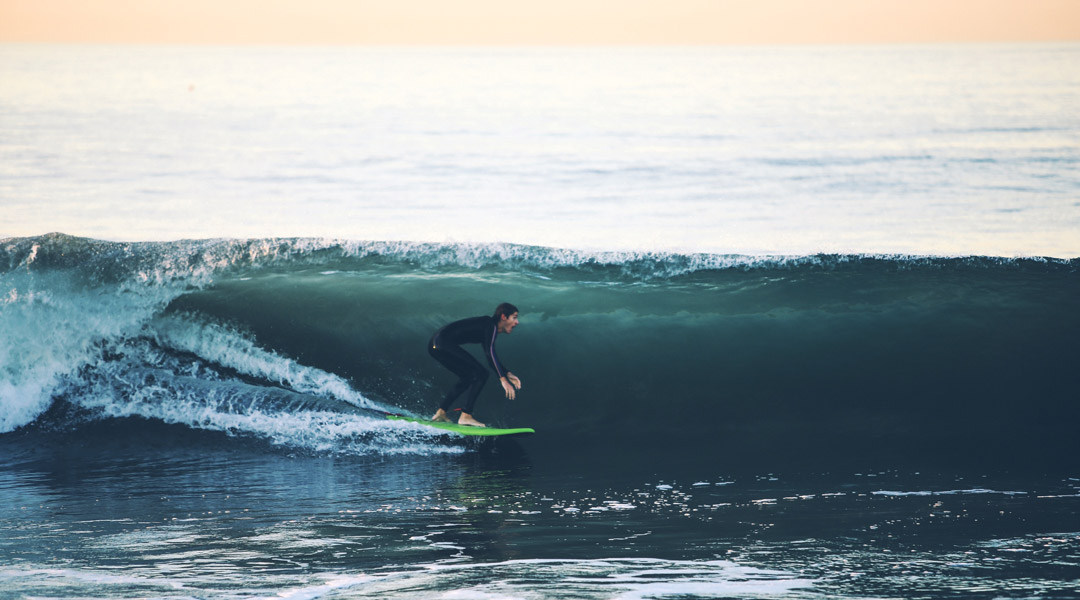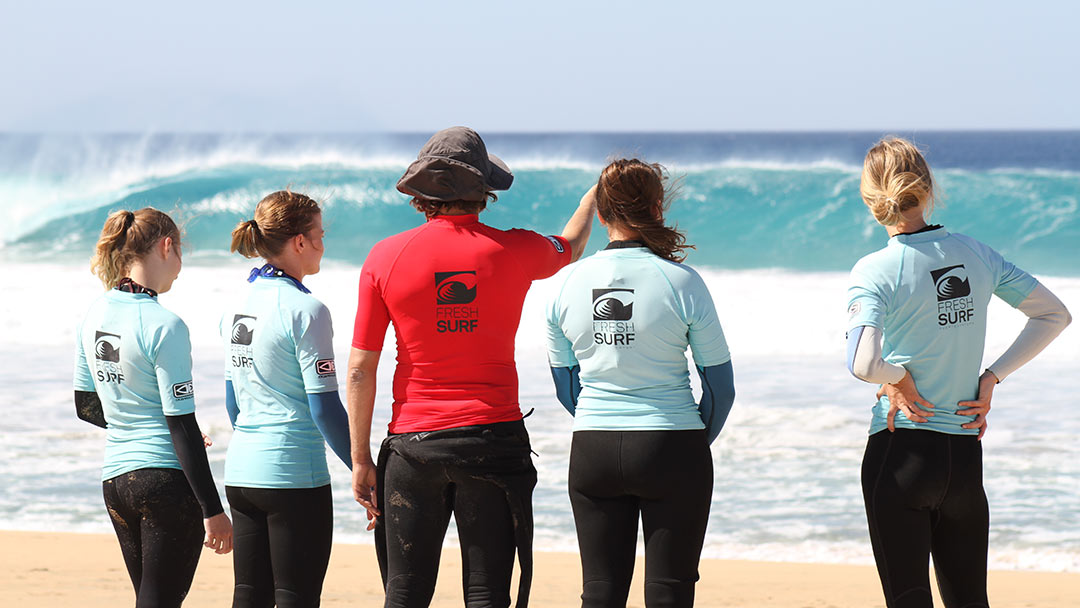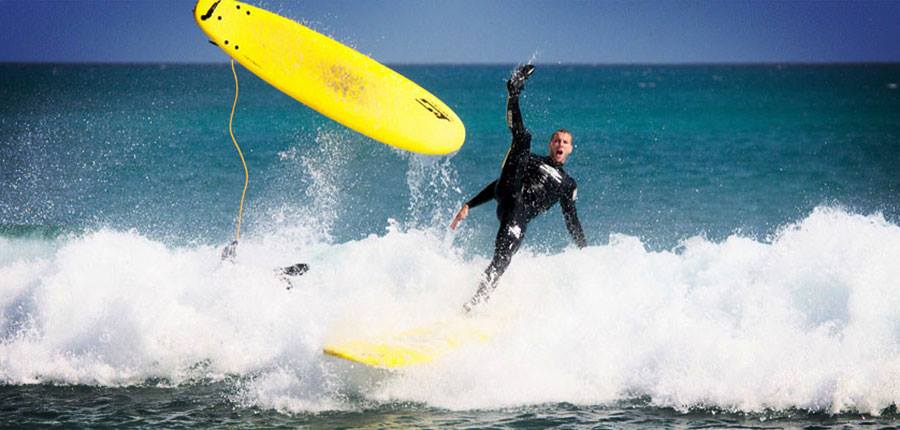

In surfing, there is often a fine line between pure joy, euphoria, and feelings of happiness on one hand, and paralyzing panic and fear on the other. It’s a balancing act that comes with the territory in extreme sports. But maybe that’s exactly what makes these sports so special.

Anyone who’s ever been surfing knows that a good wipeoutGetting tossed around—or, as we like to say in German, “a spin in the washing machine”—is just as much a part of surfing as that inner sense of joy after catching a great wave! Still, negative experiences in and under the water can sometimes push that healthy respect for the waves too far. In the worst case, this can lead to outright fear of surfing and mental blocks. What used to be such a beautiful experience—becoming one with the water and the waves—turns into a huge struggle. At the sight of the vast ocean, a queasy feeling takes hold instead of euphoria. And everything that used to come naturally just doesn’t seem to work right anymore. – But how is it that we make something we love and enjoy so much so difficult for ourselves? And how can we overcome our fear and rediscover our love for the ocean, the waves, and surfing?

What is fear, and where does it come from?
Anxiety generally refers to a state of unease and vulnerability. It is usually triggered by stimuli that we perceive as unpleasant or unfamiliar. In some cases, anxiety is justified and has a deeper root cause, such as a traumatic experience. Sometimes, however, it’s simply there, and we don’t know where it comes from or how to get rid of it. During anxiety, the body goes into a state of alert. The sympathetic nervous system prepares our body for fight or flight. The heart starts pounding, blood pressure rises, our breathing quickens, and blood rushes to the skeletal muscles to prepare for the situation ahead. At that moment, the entire body is ready for action. We are wide awake, and all our focus is directed toward the dangerous situation.
Why is a little fear good when surfing?
No one likes to admit that they’re afraid. In fact, in many situations, fear isn’t our enemy at all. On the contrary!
It helps us assess situations accurately, warns us of risks, and keeps us from becoming overconfident. This is especially true in extreme sports, where the goal is to push beyond our own mental and physical limits. In these situations, fear—in the form of healthy respect—is actually essential for survival. Whether we’re climbing a mountain, jumping off a cliff, racing down a downhill trail on a mountain bike, or riding our biggest wave yet. In these situations, our fear helps us muster the necessary concentration and strength we need.

At what point does fear become a problem?
Often, a certain amount of fear—in the form of healthy respect—helps keep us from getting overconfident. But when it goes beyond that, it can be completely overwhelming. It paralyzes both body and mind and quickly leads to mental blocks. When surfing, this kind of fear is the last thing we want! Because it can quickly ruin the joy of surfing. If this fear is still there, it can happen that you overthink things at the wrong moments instead of simply trusting your body and your skills. Movements that should actually work automatically no longer work. The fun of surfing slowly fades away and is replaced by the fear of surfing. Then it’s crucial to get to the root of these fears and do everything possible to overcome them and rediscover the fun and love of surfing!
What exactly are we afraid of?
To get to the root of our fear and overcome it, the most important question we must ask ourselves is: “What exactly are we afraid of?” The fears that can arise while surfing are as individual and varied as the different surf spots around the world. Like any fear, these can be rooted in specific experiences, such as past negative encounters. Or they may simply exist—like a fundamental fear of powerful waves.
Broadly speaking, fears associated with surfing can be divided into internal and external factors. However, these often overlap.
Internal conditions:
In this case, the internal factors are primarily one’s own motor skills and abilities. Fears that often creep in include the fear of:
- doesn’t have enough paddling power
- that there isn’t enough stamina
- technical shortcomings
- Injuries
External conditions:
External conditions refer to all the external factors we need to be aware of that make surfing more difficult. Typical fears that arise while surfing include the fear of
- strong current
- waves that are too big or too strong
- the “washing machine”
- to crash to the ground during a wipeout
- Contact with the reef
- crowded surf spots and other surfers
Of course, these different fears can also overlap or be interrelated. For example, the better your paddling endurance, the less you’ll fear the current. Or the better your technique, the less you’ll fear making mistakes during the take-off. That’s why it’s important to first figure out exactly what you’re afraid of. Then you can take the necessary steps to overcome those fears. The following tips are meant to provide a foundation for tackling potential mental blocks so you can come out of the water with a smile after a successful session!

How can we overcome our fear of surfing?
To rekindle our joy of surfing and that wonderful feeling of being in the water with our board, it’s important to overcome any fears and mental blocks that have crept in—or that may have always been there. The first step is to figure out, on an individual basis, what we’re actually afraid of. Once we’ve identified our fears, there are a few small things we can pay attention to—both before heading out to surf and while in the water—to help us overcome them.
Fear of physical limitations and injuries
The fear of running out of energy in the water—whether while paddling or during a take-off—can only be overcome in one way: training, training, training! That might sound tedious, but it’s very true. – The fitter you are physically, the more comfortable you’ll feel in tricky situations in the water. And the lower the risk that you’ll run out of energy when you need it most. Plus, physical fitness naturally makes paddling and taking off easier, so with the right training, your technique will improve quickly too. You’ll find everything you need to understand your body and find the right training for surfing right here!
If you’re particularly prone to injuries and that’s exactly what you’re afraid of when surfing, then a proper warm-up and stretching routine before you hit the waves is especially important for you!
Fear of waves and currents
Many of the fears that arise while surfing—and the risk of panicking in an uncomfortable situation—can be overcome with basic background knowledge. It’s no coincidence that a good surfing lesson includes theory sessions. Understanding how waves and currents work helps you stay calm at the spot if the current does happen to sweep you away. Understanding the different phases of a wave can also be useful in the lineup. Knowledge gives you a better eye and feel for waves. The better your feel for waves becomes, the easier it is to paddle up to a wave at the right spot—without it rolling powerlessly beneath you and without it being so steep that a wipeout is guaranteed.
It can also help to first jump into the water without a surfboard, dive through the waves, and get a feel for the different forces within a wave.
Fear of the underground
If the seabed is what scares you most when surfing, choosing the right spot is crucial. Find a spot where the waves break far enough out, and always make sure there’s enough water between you and the seabed. As long as you always jump off your board sooner rather than later while in the water, you’re unlikely to get hurt. This is especially true at reef breaks! If you don’t feel ready for the reef yet, it’s better to wait a little longer.
Fear of wipeout
On top of the fear of the ground below, there’s the fear of falling and being sucked into the “washing machine.” Admittedly, there are nicer things than a good old wipeout! Seconds underwater feel like minutes; the distinction between up and down blurs, and you completely lose your bearings in the maelstrom of the white water. But even a proper wipeout takes some getting used to! The most important thing is to stay calm! The less you struggle against the wave’s force, the faster it will spit you back out. This way, you’ll use less oxygen and should definitely be able to hold your breath for the few seconds that a normal-sized wave keeps you underwater. You can read everything else you need to know about the proper wipeout here. Here’s also an article on “Don’t be afraid of the wipeout”!
Fear of other surfers in the water and crowded spots
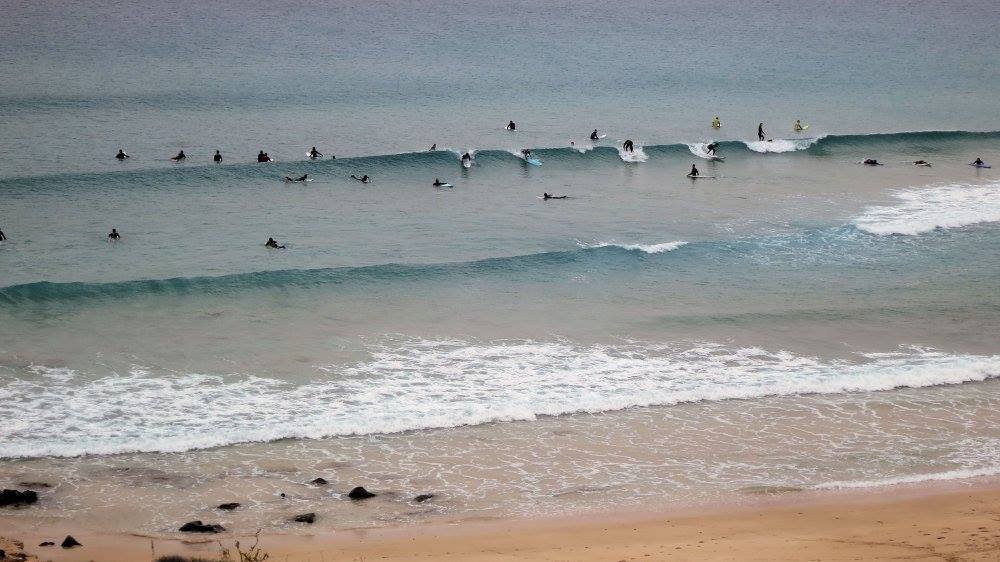
Things can get particularly uncomfortable when there are a thousand other surfers paddling around in the water right next to you. Whether you’re worried about running into someone yourself or making a mistake, or you’re afraid of getting hit in the head by another surfer’s board, crowded surf spots can be especially stressful for surfers who struggle with fears and mental blocks. So, if possible, always look for a spot where there aren’t already three surf schools in action. Being all alone at a spot can also lead to discomfort, but you should still be able to have a wave all to yourself every now and then! To ensure you don’t pose a danger in the water yourself, it’s especially important to be familiar with the rules of right-of-way when surfing.
In general, surfing has a lot to do with attitude and mindset, which is why the combination of surfing and yoga, for example, is so popular. If you discover this connection for yourself, you can enhance your surfing experience and overcome minor mental blocks simply by adopting the right attitude and doing small meditative exercises! Even professional surfers now incorporate mental training and sports psychology support alongside their regular training. Be aware that your mind is responsible for all your movement and thought patterns. This means you can learn and improve new movement sequences and techniques simply by watching videos or visualizing the movement.
Here’s a very helpful tip I once received from a sports psychologist for overcoming mental blocks while surfing:
Keep reminding yourself of your greatest surfing achievement so far! Whether you’re a beginner dreaming of your best, most challenging whitewater wave, or you’re more experienced and picturing that first beautiful green wave you might have even managed to ride sideways—hold on to that exact feeling of adrenaline, euphoria, and happiness that washed over you in that moment. If you approach your next wave with this positive mindset instead of worrying about what might go wrong, your body will automatically know what to do. That’s because it will instinctively recall your perfect wave. The likelihood of your body tensing up because you’re overthinking things will be significantly lower, and your chances of catching your next “best wave” will skyrocket!
Here are our tips for surfing without fear. We hope this will help ease your concerns and get you excited about surfing.