



Surfing Fuerteventura
Find out everything you ever wanted to know about surfing!
Surfing is more than a sport – it’s an experience that connects you with nature. Feel the power of the waves, experience the dynamics of the water and discover what it means to glide across the ocean on a surfboard.
Here you’ll learn everything about surfing.
What is surfing?

Surfing
Where does the term surfing come from and what does this sport mean?
Surfing is more popular today than ever, even though it has been practised for centuries. The minimal equipment and the direct connection to nature make this water sport so fascinating for many people. Hardly any other sport conveys the power of the ocean so intensely. Feeling the energy of the wave beneath your surfboard, starting to glide with your own paddle strokes and finally standing up to ride the wave until the very last moment is an experience like no other.
Is surfing the mother of all board sports?
Surfing has its origins in Hawaii, where the first surfboards were made of solid wood. In Europe, surf history began in the 1950s. Since then, the surf market has evolved enormously: from manufacturing to the shapes and materials of surfboards to new techniques and styles of surfing.
Modern surfboard shapes have made the sport more versatile. Today there is the right board for every surf style and every level, and the range of techniques and manoeuvres has turned surfing into a highly developed and fascinating sport.
More information about surfing
A popular surfboard model for advanced surfers is the shortboard. With its compact design, it is perfect for fast manoeuvres and tricks on steep wave faces. For a more relaxed and smooth surf style, on the other hand, many surfers reach for a longboard. This longer surfboard allows a more laid-back approach to surfing and is ideal for long, gentle waves.
How do I learn to surf?
Before you master spectacular tubes like in well-known surf movies, the basics come first. Getting started in surfing begins with a surf course, where you can learn to surf in the whitewater. In this zone, where the waves have already broken and roll towards the beach as white foam, you gain your first experience. On gentle beach breaks you practise the basics: paddling into the wave, the take-off and your first rides.
Before you venture into green waves, you’ll learn in surf theory how waves form, how to read them and what information you can use to get safely out to the line-up. That’s where the real wave hunt begins. To give you a comprehensive overview of surfing, we have gathered all the important information for you on our website. Nothing stands in the way of your surf experience!
The history of surfing

From its origins to today: the history of surfing
The origins of surfing in Polynesian culture
Surfing was an integral part of Hawaiian culture and deeply embedded in the island’s social structures and myths. Chiefs demonstrated their power and status through their skills on the surfboard, while a commoner’s social rank depended on how well he could handle the ocean.
The roots of surfing can be traced back to 2000 BC, when the first people migrated from Asia to the eastern Pacific. In the 4th century BC, Polynesian settlers reached Hawaii and brought their traditions with them, including surfing. These people were characterised by their extraordinary knowledge of the sea and a boundless love of nature, which still shapes the essence of surfing today.
The development of surfing in Hawaii
When Captain Cook landed in Hawaii aboard the Discovery in 1778, surfing had long been a central part of Hawaiian history. Many places were already dedicated to legendary surfing events, and special rituals accompanied the making and blessing of new surfboards. These ceremonies were not only meant to call up the swell, but also to give strength and confidence to the brave men and women who took on the big waves.
The history of surfing: from cultural heritage to commercial success story
How Duke Kahanamoku made surfing known around the world
In 1915 the world took notice of Duke Paoa Kahanamoku, an outstanding athlete who was not only a three-time world champion in the 100-metre freestyle but was also considered one of the best surfers in Hawaii. As a respected actor and ambassador of the sport, he used his international fame to make surfing known beyond the borders of Hawaii.
During a swimming exhibition in Australia in 1915, Kahanamoku made surf history: he spontaneously crafted a surfboard from pine wood and demonstrated his skills at Freshwater Beach in Manly. The impressive demonstration caused a sensation and laid the foundation for Australia as one of the world’s leading surf nations.
In the following decades – the 1930s, 1940s and 1950s – innovations in surfboard manufacturing drove the development of the sport further. Ever faster and lighter boards allowed surfers to perform more demanding manoeuvres and to explore new limits of surfing.
The history of surfing: the dawn of the modern era
The surfboard revolution and the rise of surfing
In 1946 a new era began for surfing when Bob Simmons revolutionised the classic wooden surfboard. He developed a foam-filled board with balsa wood rails and a plywood deck. Shortly afterwards, Pete Peterson set another milestone by creating the first fibreglass board, which at just 12 kilograms was much lighter and easier to handle.
In the early 1950s, Jack O’Neill brought another innovation to the market: the first neoprene wetsuit. It allowed surfers to stay active in colder waters as well and opened up completely new possibilities for the sport. At the same time, California experienced a real surf boom. Hollywood discovered surfing, and films like “The Endless Summer” made the sport and its lifestyle famous worldwide.
Surf fashion developed along with the boom: boardshorts became a must-have, accompanied by the unmistakable sound of the Beach Boys, which perfectly captured the mood of the time. But it wasn’t only the lifestyle that changed – so did the surfboards. They were now made of plastic, mass-produced and ever shorter, which made them more versatile and accessible. At the same time, however, surfing moved away from its traditional Hawaiian roots.
Today surfing is a global industry. There are countless surf magazines, films, videos and websites about surfing. The market has grown into a billion-dollar industry that inspires surfers and fans all over the world.
Surfing with FreshSurf

Why FreshSurf is the right choice for your surf adventure
FreshSurf combines professional surf lessons with a relaxed, easy-going atmosphere. Our experienced and licensed surf instructors not only know the best surf spots on Fuerteventura, they also place great importance on individual coaching. In small groups you can make quick progress and improve your surf level in a targeted way.
What makes FreshSurf special?
- Small groups for intensive, personal lessons (max. 6 people per instructor).
- High-quality boards and equipment for optimal conditions.
- A focus on safety and practical exercises to make learning to surf as easy and safe as possible.
With FreshSurf you learn to surf in an environment that puts both professional standards and the fun of the sport first.
What does surfing for beginners look like?

Learn to surf with other beginners
Learning to surf is possible for everyone – with the right start and the right support. In our FreshSurf surf camps in the Canary Islands we offer surf courses with experienced, licensed instructors. The courses are designed especially for beginners and give you a varied and safe start into the world of surfing. Small groups with a ratio of 1 instructor to a maximum of 4 students ensure that you receive individual attention and make quick progress.
Our surf school teaches you the most important basics of surfing – both in theory and in practice. These include basics such as safety in the water, recognising and understanding waves, the right equipment and the right-of-way rules. Our surf theory sessions complement the practice and give you valuable tips so that you are perfectly prepared to ride your first wave.
What do you learn in a beginner surf course?
The course starts with a thorough safety briefing and an introduction to the equipment. Then you learn step by step how to take the right position on the surfboard and how to control the board. The first exercises include proper paddling, followed by the so-called “take-off” – standing up on the surfboard. With every session you become more confident and can finally ride your first waves in the whitewater.
What do I learn in surfing for intermediates?
How do you improve your surfing skills?
While there are numerous surf schools for beginners, the offer for intermediate and advanced surfers is often limited. Those who have already gained some basic experience can manage on their own in many situations, but it is precisely at this stage that targeted coaching can make the difference. An experienced surf instructor not only recognises weaknesses in your technique but also gives valuable tips to effectively improve your surf level.
Targeted error analysis and individual development
In our intermediate surf courses we help you recognise the most common mistakes and work on them systematically. Together we analyse your paddling technique, your take-off and your positioning in the line-up. We help you choose the right waves and avoid switching to a shortboard too early. Instead, we focus on your individual goals and develop a training plan that takes you forward step by step.
Our experienced surf instructors not only support you in the water but also offer valuable training methods on land. With surfskate training we train your muscle memory and improve your balance and your movement patterns. This training perfectly complements the work in the water and helps you refine your feel for surfing.
Taking your surfing to the next level
With individual coaching, motivation and mental coaching, we help you find your surf flow. Our surf school not only teaches you technical skills but also the knowledge you need to assess your surf level realistically and set achievable goals. Whether through targeted corrections of your stance or new tricks we teach you – with us you will take your surfing to a new level.
What does surfing mean for advanced surfers?

Perfect your take-off when surfing and practise different take-off variations
Surf courses are not only for beginners but also for advanced surfers. If you see yourself in this category, we would always recommend private surf coaching. With a ratio of 1 instructor to 1 student, the focus is always directly on you, you can work on your individual skills and expand your surf knowledge. It’s all about your weaknesses and your goals. You have the undivided attention of a surf instructor.
How do I take my surfing to the next level?
Where can you go surfing with the whole family?
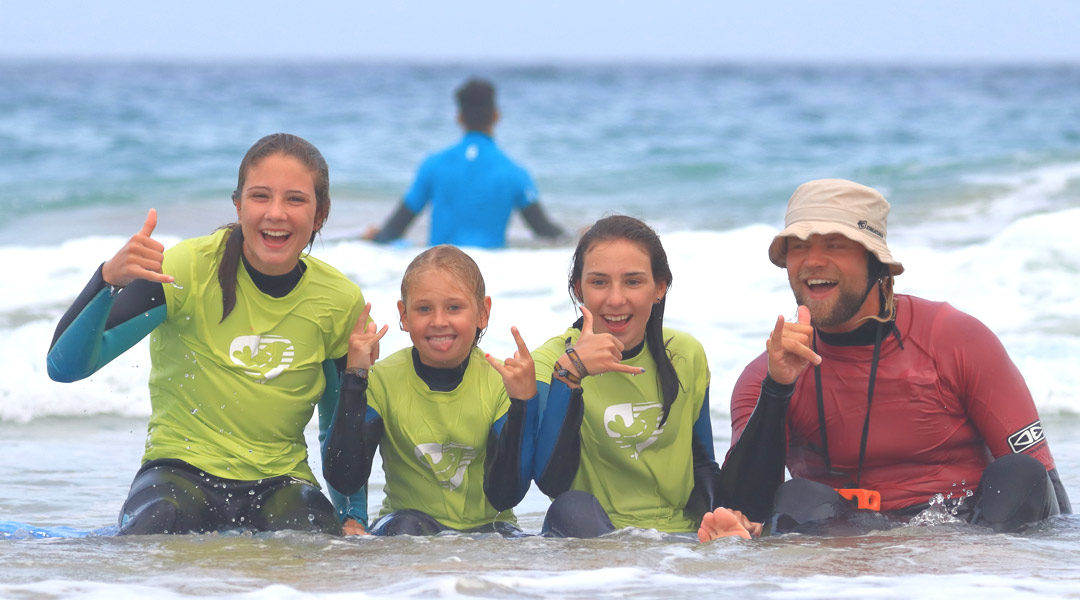
Into the water with the whole family – surfing for young and old
Surfing is a sport that connects generations. Whether child, teenager or parent – surfing offers an exciting experience for every age group. In our family surf camp you’ll find courses tailored specifically to the needs of children, teenagers and adults. Children can learn to surf with us under professional guidance from the age of six – the only requirement is that they can swim confidently.
A mix of surf adventure and relaxing beach holiday
Our family surf courses combine sporting activity with relaxing hours by the sea. Experienced surf instructors accompany both parents and children during their first attempts at paddling and standing up on the surfboard. We place great importance on taking the different needs of the participants into account. Children learn the basics of surfing through play, while adults can make their own progress.
For the best possible start, we equip you with suitable surfboards and wetsuits, individually adapted to size and ability. Safety and having fun together are always the top priority.
Individual courses for every age and every level
Whether beginner or advanced – we have the right course for everyone. Families who want to surf together can opt for combined sessions that integrate children’s and adults’ courses. That way you experience surfing as a shared adventure and share unforgettable moments in the water.
Our family surf courses offer the perfect mix of activity and relaxation. Enjoy time by the sea together, learn to surf and create memories that last a lifetime.
Where is the best place to surf?

Where are the best waves?
What does the perfect surf spot look like for you? Endless dream beaches, consistent waves and a breathtaking backdrop? The choice of surf destinations worldwide is huge – from the coasts of Europe to the Canary Islands to exotic destinations such as Indonesia, the Maldives or South America. Every place has its own charm and offers unique conditions for surfers.
What matters when choosing a surf spot?
Choosing the right surf destination depends on various factors. Aspects such as the weather, the wave forecast and the season play a central role. The type of waves you want to surf – beach breaks or reef breaks – and your own surf level are also decisive. Some places mainly offer gentle waves for beginners, while other spots are ideal for experienced surfers.
The Canary Islands are particularly popular because they offer mild temperatures all year round, consistent waves and a varied landscape. For many surfers they are the ideal place to learn to surf or to develop further. You can find more information on our page about surf camps in the Canary Islands.
Personal advice for your surf holiday
Not sure which destination suits you? Whether you want to step onto a surfboard for the first time or are already advanced – we’ll help you find the right place for your next surf holiday. Feel free to contact us for personal advice to make sure you find the perfect wave for you.
What makes Fuerteventura special for surfing?

Surfing on Fuerteventura – your home by the sea
Fuerteventura is often called the “Hawaii of Europe” – and for good reason. The Canary Islands, also known as the “Islands of Eternal Spring”, offer a unique combination of ideal waves, breathtaking nature and a mild climate all year round. Whether you are a beginner or an experienced surfer, on Fuerteventura you’ll find the best conditions for an unforgettable surf holiday.
Perfect surf conditions and an impressive backdrop
The Canaries are known for their diversity: each island has its own character and offers waves for every surf level. From gentle beach breaks to challenging point breaks that run over lava reefs – every surfer gets their money’s worth here. Fuerteventura stands out in particular for its endless dream beaches, crystal-clear water and an impressive volcanic landscape. For the adventurous, there are remote surf spots where you are sometimes completely alone in the water.
An ideal destination for your surf holiday
Only about four hours’ flight from Germany, Fuerteventura offers a welcome escape from everyday life – especially in the winter months. With constant sunshine, warm temperatures and a relaxed atmosphere, the island is one of the best surfing destinations in Europe. Besides first-class surf conditions, you’ll also find lively local cuisine and plenty of opportunities to relax and recharge your batteries.
Experience the diversity of the Canaries with FreshSurf and discover why Fuerteventura is our home by the sea. We look forward to accompanying you on your surf adventure.
Surf season and temperatures

When is the best season for surfing in the Canary Islands?
The ideal surf season in the Canary Islands – and on Fuerteventura in particular – is between October and April. During this time the waves are especially consistent and the swells become increasingly powerful. The conditions on the islands offer surfing opportunities for every level: beginners, intermediates and advanced surfers all find ideal spots here. In addition, the trade winds drop more often, which leads to clean, powerful waves – perfect for demanding surfers.
With its numerous reef breaks, Fuerteventura offers a wide variety of waves that are a true playground for beginners and experienced surfers alike. If you travel outside the high season, you can often enjoy the surf spots almost to yourself.
Climate and temperatures on Fuerteventura
Fuerteventura is a year-round destination with pleasant temperatures. In summer, temperatures climb up to 30 degrees, accompanied by tropical humidity in the months of July to September. Even in winter, the mildest period, daytime highs hardly drop below 20 degrees.
The water temperatures are ideal too: they range between 18 and 22 degrees throughout the year. This means surfing is often possible with minimal neoprene – ideal for anyone who doesn’t want to compromise on comfort even in cooler conditions.
Find out more about the consistent conditions and the best surf spots on our page about surf courses on Fuerteventura.