



Surfboard Types: 6 Shapes and Their Differences
More suitable waves, a calmer take-off or your first flowing turn: which surfboard brings you closer to your next goal? Get to know 6 surfboard types and discover what to look for when you try a different board.
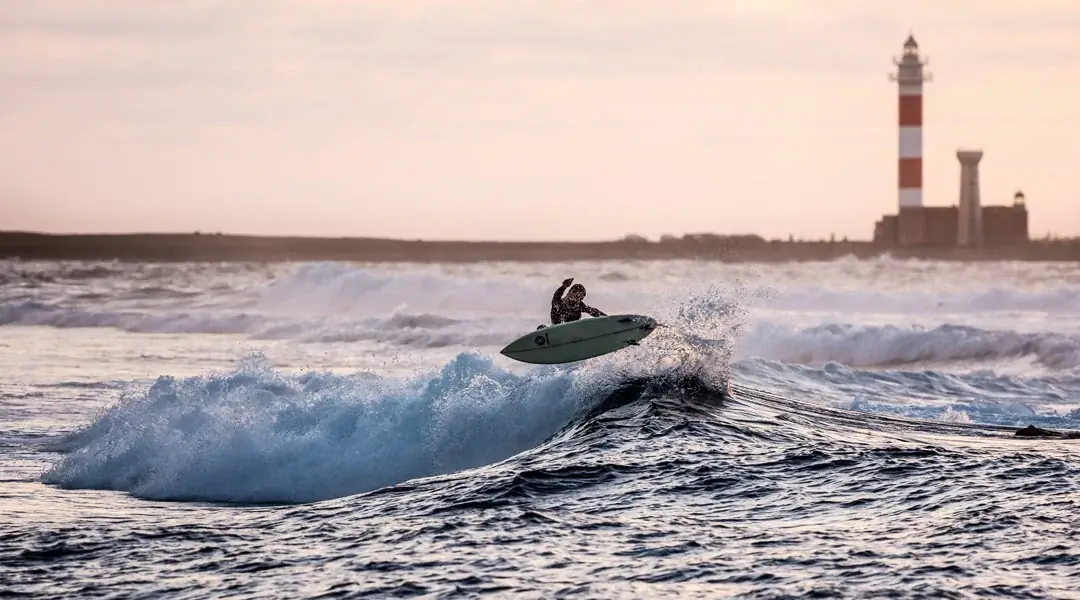

A surf day brings people together: head out, share the moment and enjoy time by the sea.
Which surfboard suits me?
Choose a surfboard for your ability, the wave profile and your next learning goal. A wide learning softboard supports your first take-offs. Mini-malibus and suitable midlengths can help you catch waves early and follow flowing lines. A fish or performance shortboard requires more control as you take off and ride.
Softboard describes construction. Longboard, fish and shortboard mainly describe shape and use. A fish can therefore also be a softboard. Surfboard types give you a starting point; the actual model still makes the difference.
For your first board choice, read our guide to choosing a surfboard for beginners.
6 surfboard types worth knowing
These realistic AI model illustrations show the deck on the left and the underside with one typical fin setup on the right. They represent board families; sizes and details vary between models. The boards are not shown to a common scale and do not represent specific boards in our rental stock.

Softboard
A learning softboard usually has a full nose and a broad standing area. It supports paddling, standing up and repeating the basics. Its softer surface can reduce the consequences of contact with the board.
When to try it: For your first controlled take-offs and for practising the foundations. A wide learning model can also be enjoyable for experienced surfers on small days.
Before you choose: A short performance softtop behaves differently from a large learning board. The soft upper surface alone tells you little about suitability.

Mini-malibu
This longboard-inspired shape often has a wide, rounded nose and a relatively flat entry rocker. It offers considerable surface area without the length of a classic longboard.
When to try it: When you want to consolidate your take-off and ride small, less steep waves along the face. Experienced surfers also choose suitable models for relaxed lines.
Before you choose: Mini-malibu is not a universal beginner label. Finer rails and more performance-focused versions can require much greater precision.

Midlength / funboard
Midlength is a broad category. Many models combine a longer rail line with the ability to draw wide, flowing turns. Egg, funboard and hybrid descriptions overlap between manufacturers.
When to try it: When you take off reliably and want earlier glide, trim and wider arcs. The particular model needs to match the waves you intend to ride.
Before you choose: Length and litres alone do not explain how forgiving a board will be. A performance midlength can be more demanding than a full mini-malibu.

Longboard
A long outline supports early wave entry and extended gliding. Classic models often focus on trim and moving along the deck; performance longboards have different priorities.
When to try it: For soft, open waves and flowing lines, provided you can control the length in the water. Longboarding is also a distinct goal for experienced surfers.
Before you choose: Carrying it in wind, turning and managing whitewater require practice. Suitability for a beginner depends on the person, model, guidance and conditions.

Fish
A fish generally has a relatively wide outline and often a swallowtail. Classic versions commonly use two fins; modern variations also include quad setups.
When to try it: When you can stand up with control and want to carry speed through suitable, softer wave sections. A fish can open up different lines from your usual board.
Before you choose: A fish is not an automatic stepping stone towards a shortboard. The short standing area and control of the wide tail and fins require skill.

Shortboard
A performance shortboard is designed for responsive manoeuvres and often has a narrower outline and more rocker. Wider everyday models have different priorities from competition shapes.
When to try it: When positioning, paddling into the wave and taking off work reliably with a shorter window, and you want to practise tighter turns on the face.
Before you choose: Less length and surface area can make catching waves harder. If your wave count drops sharply, the board may offer little help with your current learning goal.
Choose surfboard types for your goal and your waves
Use the table as a starting point. The particular model, its size and your ability to control it matter more than the name of its board family.
| Board type | Your focus | Typical setting | What matters |
|---|---|---|---|
| Learning softboard | Repeat the foundations | Calm, manageable learning conditions | A suitable learning model with enough surface area |
| Mini-malibu | Catch waves early, ride along the face | Smaller, less steep waves | Control during take-off and direction changes |
| Midlength | Trim and wide turns | Open waves suited to the model | Look closely at outline, rails and intended use |
| Longboard | Long glides, its own style | Soft-breaking, open waves | Manage the length in wind and water |
| Fish | Carry speed through softer sections | Suitable small to medium waves | A reliable take-off and control of tail and rail |
| Shortboard | Tighter manoeuvres, responsive lines | Suitable steeper wave sections | Precise positioning and independent control |

Smooth gliding or dynamic turns: your board should suit the lines you want to surf.
What line would you like to surf?
More time to stand up, a longer line or a tighter turn: start with the moment you want to experience in the water.
The table helps you compare. How well the board suits you becomes clearer when you paddle, take off and ride. Give yourself a few sessions before making up your mind.
What changes the shape of your surfboard?
A surfboard works as a whole. Outline, rocker, rails, volume distribution and fins all interact.
The top and side views are simplified. Rocker extends along the whole board.
- Outline, nose and tail
- The outline is the shape viewed from above. Nose width, wide point and tail work together to distribute the surface area. A tail name alone cannot explain how a board will ride.
- Rocker
- This is the lengthwise curve seen from the side. A flatter section can support glide in flatter parts of a wave. More curve can suit a steeper wave profile. Where that curve sits is crucial.
- Rails and thickness profile
- Rails are the edges along the sides. Together with the distribution of thickness, they influence how the board rolls onto its rail and holds a line.
- Deck, underside and fins
- You stand on the deck; the underside provides the planing surface. Fins provide direction and hold and influence turns. A stringer is one possible reinforcement in the core; some constructions use no wooden stringer.
Read more in our guide to surfboard fins.
Fin layout and attachment systems are different things
Single means one fin, twin two, thruster three and quad four. A 2+1 setup has one larger centre fin and two smaller side fins. FCS and Futures are attachment systems. Check the actual board to see which system and layout it is designed to use.
Surfboard dimensions: length, width, thickness and volume
Length affects glide and handling. Width distributes the surface area, while thickness is a measurement at a particular point. Total volume is expressed in litres. These figures help you compare surfboard types and individual models more carefully.
How to read the numbers
6′4″ × 21″ × 2¾″ means 6 feet 4 inches long, 21 inches wide and 2¾ inches thick. A foot is 30.48 cm and an inch is 2.54 cm. The example length is about 193 cm.
The litre figure describes the three-dimensional board body. Simply multiplying the outside dimensions will not give you its volume: the nose, tail, rails and thickness profile reduce and distribute that volume.
More litres are not an automatic solution. Your weight, paddling fitness, technique and the waves all belong in the decision. You also need to be able to carry, turn and control the board in the water.
Almost the same litres, a different outline
The Firewire Seaside 5′11″ is 22¾″ wide and has 41.1 litres. The Seaside & Beyond 6′8″ is 20¾″ wide and has 40.9 litres.
The second board is almost 23 cm longer and about 5 cm narrower. Their volumes are almost identical, but the surface area and its distribution differ considerably. It is a practical reason to look at boards side by side.
Dimensions from the manufacturer specifications, checked in November 2026. This is a comparison example, not a statement about the FreshSurf rental inventory.
How is your surfboard constructed?
Soft deck or hard outer skin? Feel the board and look at the rails and underside. Similar-looking surfboard types can use quite different materials.

Look at boards together and pick them up: their differences become easier to understand.
Learning softboard and soft deck
A softboard has a softer coating on its standing surface. Learning boards often also have softer rails and a different outer skin underneath. However, a laminated board can have a soft deck too. Check which parts are actually soft and which fins are fitted. The surface alone does not tell you the size or how the board rides. Even within the same surfboard types you will find different versions. When renting or buying, ask about the actual construction rather than treating the word softboard as a complete description.
Laminated hardboard
A traditional hardboard consists of a core with a firm outer skin of cloth and resin. Common combinations include PU foam with polyester resin or EPS foam with epoxy resin. The skin and shape can be produced in different ways, and additional reinforcement may be part of the construction. Cloth layers, workmanship and the complete model therefore belong in the choice. Two similar-looking boards need not feel alike. For your first green waves, being able to control the board while starting, turning and stopping remains particularly important.
EPS, epoxy and repairs
EPS is a possible foam core material; epoxy is a resin system. An EPS board is not automatically a softboard: a hardboard can have an EPS core too. Construction and shape answer different questions. Avoid assuming every epoxy board is necessarily lighter, stiffer or more durable. Check the specifications for the actual model, and keep them for any later repairs. Repair materials and methods need to suit the construction. If you are unsure about damage, a knowledgeable assessment is more useful than choosing an arbitrary repair kit.
For your comparison: record the model, dimensions, volume, construction and fin setup together. You can then connect your observations during a board test to a specific configuration, rather than comparing two similar names.
Three situations around El Cotillo
These examples show how to think about surfboard types alongside the conditions. They are decision-making scenarios, rather than current recommendations for a particular spot.
You stand up with control but quickly lose speed on the open shoulder. Compare a full mini-malibu or suitable midlength with your usual board. Notice whether you catch the wave earlier and hold your line for longer.
Your learning goal: a calmer start and a longer glide.
At Piedra Playa, a powerful swell can make waves close out across a large area. A shorter surfboard will not create an open shoulder. Reassess your location, the conditions and your ability instead of only changing equipment.
Your decision: a suitable session comes before a board change.
You struggle to control your long board while carrying it. Do not assume a smaller surfboard will also be the right answer in the water. Ask someone to show you how to handle it and assess the spot and conditions with a knowledgeable local person.
Your check: control starts on the beach.
At Piedra Playa near El Cotillo, sandbanks and sea conditions change the way waves break. Combine your board choice with our Fuerteventura spotfinder and our surfing knowledge about conditions and safety.
Test your surfboard in four steps
A comparison between surfboard types becomes more useful when you work towards the same goal and keep track of what happens.
Describe where you are now
Which waves can you catch without help? Can you ride along the face with control? How often do you actually surf? Use specific observations rather than relying only on the label “intermediate”.
Choose one change at a time
For example, you may want to catch waves earlier or draw a wider turn. Avoid reducing length, width and volume together if you will then be unable to tell which change helped.
Compare in similar conditions
Notice paddling, wave count, take-off and the first part of the ride. Record unsuccessful attempts too. One good ride is not enough to understand a new surfboard.
Keep control as a requirement
You need to carry, turn and keep the board away from other people safely. If it feels overwhelming, try a more suitable model or ask for guidance.
You do not have to change boards. If your current surfboard helps you catch more suitable waves and practise your goal, keep enjoying it. For your next step, try our self-check before switching to a hardboard.
Surfboard care: four everyday habits
Sun, wind and sand are part of life in Fuerteventura. A quick equipment check before and after your session helps you spot damage early.
Protect it from heat
Store your surfboard somewhere shaded and well ventilated. A closed car or a boardbag in direct sunshine can become very hot.
Rinse board and accessories
Use fresh water to remove sand and salt. Let the board, leash and bag dry before longer storage, and handle fin boxes and screws carefully.
Check after an impact
Inspect rails, nose, tail and fin boxes for damage. Stop surfing with an open ding. Let the damage dry and have it repaired appropriately for the construction.
Secure it for transport
Protect rails and fins from pressure and knocks. Secure your equipment appropriately for the vehicle and check the fastening before you set off.
Find more practical advice in our guide to caring for surf equipment. Follow the manufacturer instructions when storing or repairing your board.
Questions about surfboard types
Which surfboard types suit beginners?
A sufficiently large, wide learning softboard is often a good starting point. Your build, paddling strength, the waves and control in the water determine the right size. Not every softboard is a beginner board: short performance models exist too.
What is the difference between a softboard and a hardboard?
A softboard has a softer upper surface, although construction varies between models. A hardboard has a hard outer skin. Both can come in different shapes. Softboard and longboard are therefore not opposites.
How many litres should my surfboard have?
Body weight alone cannot determine this reliably. Consider ability, paddling fitness, waves and shape. Compare specific boards in similar conditions whenever possible. Equal litre figures can be distributed through very different outlines and thickness profiles.
Is a fish easier to surf than a shortboard?
A fish can carry speed more easily through suitable softer wave sections. However, its short standing area and wide tail can be demanding. It is neither automatically a beginner board nor a compulsory step before a shortboard.
What is the difference between a mini-malibu and a midlength?
The terms overlap. Mini-malibu usually describes a more compact shape inspired by a longboard. Midlength is a broader category between short and long boards. Compare outline, rocker, rails and manufacturer guidance rather than relying only on the name.
Can I rent a surfboard in El Cotillo?
FreshSurf offers board rental in El Cotillo. Check which models and sizes are available for your dates through the board rental page or directly with the team. Describe your surfing experience, usual board and the days you need.

Your surfboard for the next session: suited to your waves and your ability.
Choose a suitable board, then head for the water
Looking for a surfboard during your stay in Fuerteventura? Tell us what you usually ride, your surfing experience and your dates. That helps us discuss the available options with you.
FreshSurf offers board rental and arranges surf lessons with partners. Check equipment availability and whether the conditions suit you before your session.
Compare surfboard types in the water
How this guide was prepared
Editorial team: FreshSurf, El Cotillo, Fuerteventura. Updated November 2026. The technical explanations draw on the shaper and manufacturer sources below. Manufacturer descriptions refer to particular models; this surfboard types guide summarises typical characteristics.
The local scenarios are examples. Check equipment availability and current conditions for each session. Choosing a surfboard does not replace an assessment of the spot and your ability.
- Greenlight Surf Co. · Design Guide · How outline, rocker, rails, underside and fins work together
- Greenlight · Surfboard Building Guide · Foam cores, cloth and resin systems
- Torq · Shapes and construction · Overlap between board families and soft-deck constructions
- Buster · Mini-malibu · A specific example of a more performance-focused mini-malibu
- Channel Islands · CI Mid and FishBeard · Different lines and intended uses
- Firewire · Longboarding with Taylor Jensen · Longboard selection and a distinct surfing style
- Channel Islands · CI Pro · An example of a performance shortboard
- Firewire · Seaside 5′11″ · EU specifications · Specifications used in the volume comparison
- Firewire · Seaside & Beyond · The second model in the volume comparison