
You’re sitting on your board, looking toward the horizon. A wave is coming. Suddenly, two surfers next to you turn around and start paddling. You watch them go and think:
It looked just like the last five.
This is exactly where an important step in surfing begins: You’re no longer just learning how to ride a wave, but which wave you want to catch—and where you need to be to do so.
At first, the ocean can seem like quite a chaotic mess. Over time, you’ll start to see patterns in it.
Four things in particular will help you get started: the peak, the open face of the wave, the direction of the break, and your position.

When you’re in the water, these five questions will help you:
- Where will the wave break?
- Where is the wave wall open?
- Which way is she running?
- Am I positioned correctly?
- Is this wave right for me and my current situation?
That last point is absolutely essential. Just because you can read a wave correctly doesn’t automatically mean you should ride it.
Choosing the right wave also means consciously letting a wave pass you by.
💡“Spot the peak. Look for an open face of the wave.
Read the direction of the wave. Check your position.
Then make a decision!”
Why Your Takeoff Isn’t Always the Problem
Here at our surf camp, we see time and again that when transitioning from whitewater to green waves, many people focus on the takeoff first.
But even the best takeoff won’t do you much good if you’re waiting for the wrong wave in the wrong spot.
When you catch a green wave, your surf ride starts a few seconds earlier:
Observe → Assess → Position → Decide → Paddle → Take-off
So if waves are constantly passing under your board or you’re having trouble getting into the right starting position, it doesn’t necessarily mean that standing up is the problem.
Perhaps the key improvement comes even before the first paddle stroke.

The part of the wave that is about to break is marked in green. The circle marks the peak—the highest point of the wave—which breaks first.
1. Find the peak: Where does the wave start to break?
Watch a wave as it rolls toward the beach.
Usually, the entire wave doesn’t break all at once. One section builds up more, becomes steeper, and begins to break first. This section is often referred to as the peak.
It’s crucial for your positioning.
If you’re positioned too far out, the wave might still be too flat where you are. You paddle hard—and yet it still slips right under you. If you’re positioned too far in, it might already start to break before you can ride it in a controlled manner.
You can find many more tips on the topic of positioning can be found in this article.
💡“Don’t just look for the highest point. Watch where the wave gets steeper and where it’s likely to start breaking.”

The ideal position would be within the yellow circles.
2. Find the Open Wave Face – the Shoulder
Once you have spotted the possible peak, look along the wave from there.
The key question now is:
Which part of the wave has not broken yet?
When a wave starts to break, one section turns into whitewater while the part next to it can still have a smooth, unbroken face. This open part of the wave is called the shoulder.
This is the part you want to look for because it gives you space to surf along the wave instead of heading straight into the breaking whitewater.
An easy way to remember it:
Peak = Where does the wave start to break?
Shoulder = Where is there still a smooth, unbroken wave face to surf?
Imagine the wave starting to break in the middle. If the wave face to the right of that breaking point is still smooth and open, the wave may offer you a ride to the right. If it stays open on the left, it may offer you a ride to the left. Some waves stay open on both sides, while others break across a large section almost all at once.
That is exactly why looking only at the size of a wave is not enough.
Observe the shape and development of the entire wave. A wave that looks promising further out can lose its shape as it approaches you. Another may only start to build properly later on.
You can find out more about the different zones of a wave here: Wave Energy Zones!

1 Peak
2 Open wave face / Shoulder
3 Direction of the wave (right or left)
3. Left or Right? How to Read the Direction of a Wave
Found the peak? Then let your eyes follow the wave from there.
The side where an open wave face remains next to the breaking section shows you which direction the wave can run.
A wave is called a right or a left based on the direction the surfer rides when facing the shore:
Right = From the peak, the surfer rides to their right.
Left = From the peak, the surfer rides to their left.
This can feel confusing when you are watching from the beach because you are facing the surfer. From your perspective, the directions appear reversed.
So instead of thinking only about left and right, look at the wave itself: Where is the peak, and on which side of it does the wave face stay open?
That sounds pretty simple when you’re standing on the beach.
In the water, however, you also have to deal with board control, positioning and other surfers. That’s why it’s worth practising this skill first in a place where you can focus entirely on the wave:
on the beach.
Pick an incoming wave and decide as early as possible:
Left, right, or no suitable open wave face?
Then watch what actually happens.
Where does it break? Does the side you expected stay open? Does the wave close out faster than you thought?
This comparison is exactly what helps train your wave-reading skills:
What do I expect? → What actually happens?

1 Too far out on the shoulder – the wave is still too flat
2 Perfect positioning
3 Too far inside – the wave is already too steep and breaking
4. Check Your Position Before You Paddle Harder
A promising wave is coming. You turn your board, paddle hard – and it still passes underneath you.
Your first thought might be:
I need to paddle harder.
Maybe. But before you use more power, check your position.
If you are sitting too far outside, you are too far away from the area where the wave is becoming steep and starting to break. The wave may still be too flat to pick up your board, so it simply passes underneath you.
If you are sitting too far inside, you are too close to the breaking point. The wave may already be too steep, break on top of you or leave you with too little time for a controlled take-off.
Use this quick check after every attempt:
Wave passes underneath you? → Move further inside, towards the breaking point.
Wave breaks on you? → Move further outside, towards deeper water.
Wave picks you up smoothly? → Stay around this position.
Small adjustments are usually enough. Moving just a few metres can make a noticeable difference.
After each attempt, look back at the wave:
Where did it actually break – and where were you?
Then adjust your position before the next wave arrives.
This way, even a missed wave gives you useful information for the next one. Instead of simply paddling harder, you gradually learn where you need to be before you start paddling.
And if your position is right but you still struggle to catch the wave, it may be time to work on your paddling. You can find our tips on how to get more paddling power here!


Use Landmarks on Shore
When you’re sitting on your surfboard, it can be surprisingly difficult to tell whether you are still in the right place.
The ocean is constantly moving you. Even if you feel like you are sitting in the same spot, you may have drifted several metres without noticing. We see this happen all the time in our surf lessons.
A simple trick is to choose something easy to recognise on shore, such as a building, a large rock, a tree or a distinctive part of the coastline.
For example, imagine this view from your board:
White house directly in front of you + large rock to the right = your position
A few minutes later, check the same two landmarks again:
White house now to your left + rock further to your right = you have drifted
Think of your landmarks like a simple picture you want to keep the same. If the picture changes, your position has changed too.
Use your landmarks to ask yourself regularly:
Am I still in the same place, or have I drifted to the left, right, further inside or further outside?
This makes it much easier to notice when you are drifting and reposition yourself before the next wave arrives.
Keep in mind, though: landmarks only help you see that you are moving. They don’t tell you why you are moving or whether a current is safe and manageable for you.

💡 “If you’re not sure whether the waves, currents or conditions are safe for your level, don’t go surfing alone. Choose an easier surf spot or surf with an experienced instructor or surf school who can help you find conditions that match your ability.”
5. Don’t Just Ask: Can I Catch This Wave?
You’ve spotted the peak, found the open wave face and checked your position. The wave looks good and you might be able to catch it.
But there is one more question to ask before you start paddling:
Is this actually the right wave for me?
Catching a wave is not only about being in the right place at the right time. Especially as a beginner, you also need to check whether you can handle the situation safely.
So don’t just ask yourself:
Can I catch this wave?
Also ask:
Should I take it?
Look around before you paddle. Make sure you can see the other surfers around you, understand who has priority and feel comfortable with the size, power and speed of the wave.
Let the wave go if:
-
another surfer has priority or is already riding the wave,
-
you are clearly out of position,
-
you are not sure which direction the wave will break,
-
you could put another surfer in danger,
-
the wave or situation feels beyond your current ability.
If you’re unsure, letting one wave pass is usually the better choice. There will always be another one.
Not every wave you can catch is automatically the right wave for you.
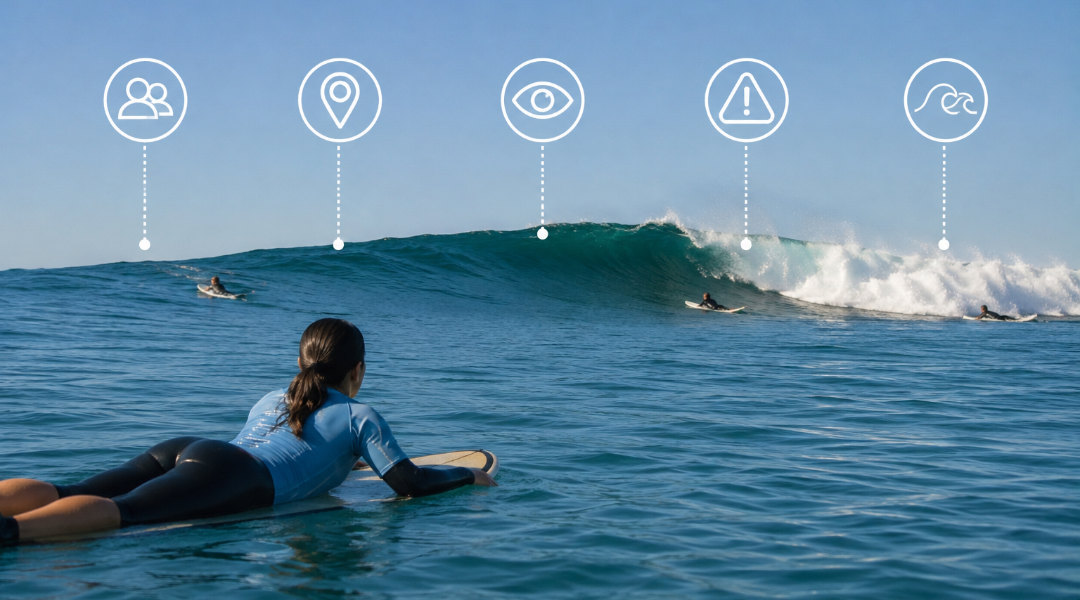
💡 “Good wave selection is just as much about knowing which waves to let go as knowing which ones to take.”
Which Waves Are Best for Beginner Surfers?
The biggest wave is rarely the best wave to learn on.
When you’re starting to surf green waves – waves that have not broken yet and still have a smooth, unbroken face – look for conditions that give you enough time to observe, position yourself and make a decision.
Unlike whitewater, where the wave has already broken, a green wave requires you to recognise where it will break, position yourself correctly and paddle into it at the right moment.
A suitable beginner wave should ideally give you enough time to:
-
paddle into the wave in a controlled way,
-
recognise which direction the wave is breaking,
-
complete your take-off without having to rush,
-
surf along a clearly visible open wave face.
Very steep or fast waves give you much less time to do all of this.
As a beginner, your goal is therefore not to catch the most spectacular wave. Attempts where you understand why a wave worked – or why it didn’t are much more valuable for your progress.
You can find even more tips about learning to surf in our Beginner’s Guide to Learning How to Surf.

The Best Way to Practise Reading Waves Starts on the Beach
Before your surf session, take a few minutes to simply watch the ocean.
Don’t just look at where a wave is breaking right now. Try to recognise patterns:
-
Where do most waves break?
-
Can you identify a clear peak?
-
Where do the wave faces stay open?
-
Do the waves tend to break to the left or to the right?
-
Does the breaking area move?
-
Where are the other surfers sitting, and which route do they take to paddle out?
-
Do several waves arrive one after another?
Try the 5-Wave Exercise
Before you enter the water, choose five incoming waves and try to predict what each one will do.
For every wave, ask yourself:
1. Where will it break first?
2. Which side will stay open?
3. Will it break to the left, to the right or close out?
Then simply watch what happens.
Were you right? Did the wave break where you expected? Did the open face stay open, or did it close faster than you thought?
Don’t worry about getting every prediction right. The goal is to start noticing the small clues that tell you what a wave is likely to do.
Take the Same Questions Into the Water
Once you paddle out, use the same process when you see a wave approaching:
Where will it break? → Which side will stay open? → Am I in the right position?
Your answers help you decide what to do next:
Good wave + good position + clear open face? → Get ready to paddle.
Good wave but wrong position? → Let it pass and adjust your position.
Not sure what the wave will do? → Watch it and learn from it.
The beach gives you time to practise reading waves without also having to paddle, balance on your board and watch other surfers. In the water, those same observations become real decisions.
The more often you compare what you expected with what actually happened, the faster you’ll learn to recognise the important signs before the wave reaches you.

Exercise Before Your Next Surf Session
Before you paddle out, stand on the beach and choose five individual waves approaching the shore.
For each wave, make your prediction as early as possible:
1. Where will it break first?
2. Which part of the wave will stay open?
3. Will it break left, right or close out?
Make your decision before the wave starts breaking. Then watch it all the way through and compare your prediction with what actually happens.
After each wave, quickly check:
Was I right? → What did I miss? → What could I recognise earlier next time?
Do this with five waves before you enter the water. Once you paddle out, try to use the same three questions when choosing your next wave.
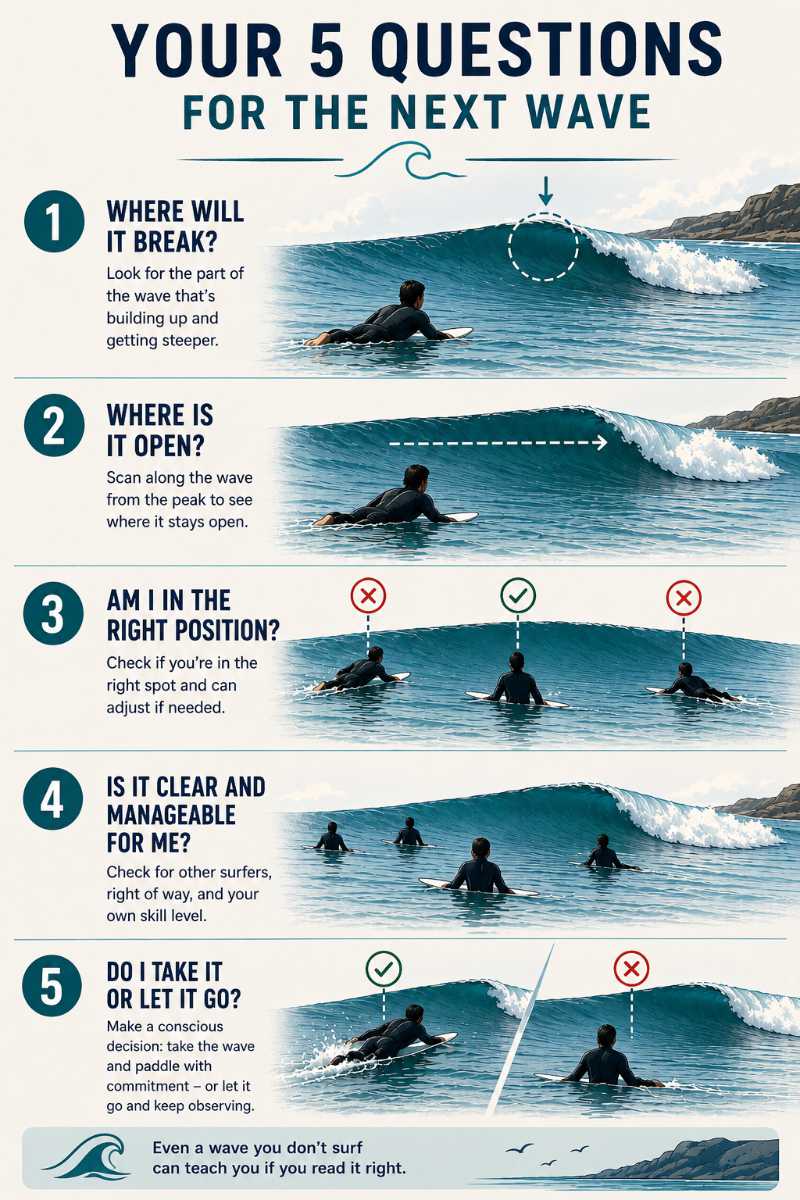
Your 5-Question Checklist for the Next Wave
When a wave approaches, you don’t have time for a complicated analysis. Keep it simple and run through these five questions:
1. Where will it break? → Find the peak.
Look for the part of the wave that is building up and becoming steeper.
2. Where will it stay open? → Find the shoulder.
Look to either side of the peak for a smooth, unbroken wave face.
3. Am I in the right position? → Adjust if needed.
Too far outside? Move towards the breaking point. Too far inside? Move towards deeper water.
4. Is it clear and manageable? → Check before you go.
Look for other surfers, check who has priority and make sure the wave matches your ability.
5. Am I taking it? → Decide and commit.
Yes? Turn, paddle and go.
No? Let it pass and watch what happens.
Even a wave you don’t surf can show you whether you read it correctly.
Want to Practise Reading Waves in the Water, Not Just From the Beach?
If you want to start surfing your first green waves with structured guidance, you can find more information about the FreshSurf beginner surf course here.