



Triathlon Training on Fuerteventura:
Swimming, Cycling, and Running Between the Atlantic and Volcanic Landscapes

Image: AI-generated
On the bike in the morning, later in your running shoes or in the water – and in the evening, sitting by the Atlantic with tired legs. Fuerteventura offers much of what a good triathlon training camp needs: long outdoor sessions, varied terrain, and options for cycling, running, and swimming training.
One special feature, however, accompanies you almost everywhere:
On Fuerteventura, you don’t just plan your training around kilometres and elevation gain. You also plan around the wind.
Image: AI-generated
Why is Fuerteventura well suited for a triathlon training camp?

Image: AI-generated
The strength of Fuerteventura lies in the combination. You can go on longer road bike rides, run on asphalt or trails and – if conditions and experience allow – swim in the Atlantic.
However, the island is by no means flat everywhere. Depending on the route, the journey includes longer undulating stretches, climbs, and volcanic terrain.
When it comes to running, the options range from easy-to-navigate paths to sand, volcanic gravel, and more challenging trails.
That’s exactly what makes it so convenient: You can choose the terrain to match the unit.
For a relaxed, basic run, a paved path is often a better choice than even the most spectacular volcanic trail. Sand, elevation gain, and trails, on the other hand, can specifically provide an extra challenge for strength or coordination.
Image: AI-generated
Where to train on Fuerteventura? The key regions compared
For a training camp, your location makes a big difference. What matters is not which place is generally “the best”, but how quickly you can get from your accommodation to the training options.
| Region | Particularly interesting for |
| Corralejo, La Oliva, Villaverde | Running, cycling training, combining with surfing |
| Lajares, El Cotillo | Trails, outdoor sports, surfing |
| Las Playitas, Gran Tarajal | Triathlon facilities, pool, gym, cycling, and running |
| Betancuria, Pájara | Elevation gain, more challenging cycling and trail runs |
| Jandía, Morro Jable | Longer endurance sessions and training in the south |

Image: AI-generated
Triathlon training in the north of Fuerteventura
Corralejo, La Oliva, Lajares and El Cotillo
The north is a good fit if you want to combine triathlon training on varied running surfaces with surfing.
Between Corralejo, Villaverde, La Oliva, Lajares and El Cotillo, you’ll find open volcanic landscapes, roads, paths and trails. Around Corralejo, there are also the dunes and long stretches of coastline.
For swimming sessions, there is also municipal infrastructure: the municipality of La Oliva runs a heated indoor Piscina Municipal in La Oliva and an Olympic-size outdoor pool in Corralejo. Check current opening hours, lane use and access directly before your training camp.
Triathlon Training in Lay Playitas and Gran Tarajal
Short distances for structured training
If swimming pools, a gym, and cycling infrastructure are key components of your training plan, the area around Las Playitas is particularly appealing.
ThePlayitas Resort features a 50-meter heated pool with eight lanes, running trails, a cycle center, and various other training facilities. Among other amenities, the pool offers starting blocks, training equipment, and an underwater gallery for technique analysis.
In addition, there is a 700-square-meter gym with cardio, strength training, and free-weight areas. Other facilities include a WOD Box, an outdoor gym, and additional sports areas. Some activities or facilities may require additional fees or advance reservations.
For a classic triathlon training camp with the shortest possible distances between swimming, cycling, running, and strength training, this is one of the most comprehensive training facilities on the island.

Triathlon Training in Betancuria and Pájara
If you’re looking for elevation gain
In the interior, Fuerteventura becomes noticeably hillier. Routes here are more interesting if you deliberately want to build climbs or more demanding runs into your training plan.
The official Betancuria Trail, for example, is around 15 kilometres long with roughly 1,000 metres of elevation gain through mountainous and, in places, rocky terrain. This is not a route for an easy recovery run, but a demanding session in its own right.
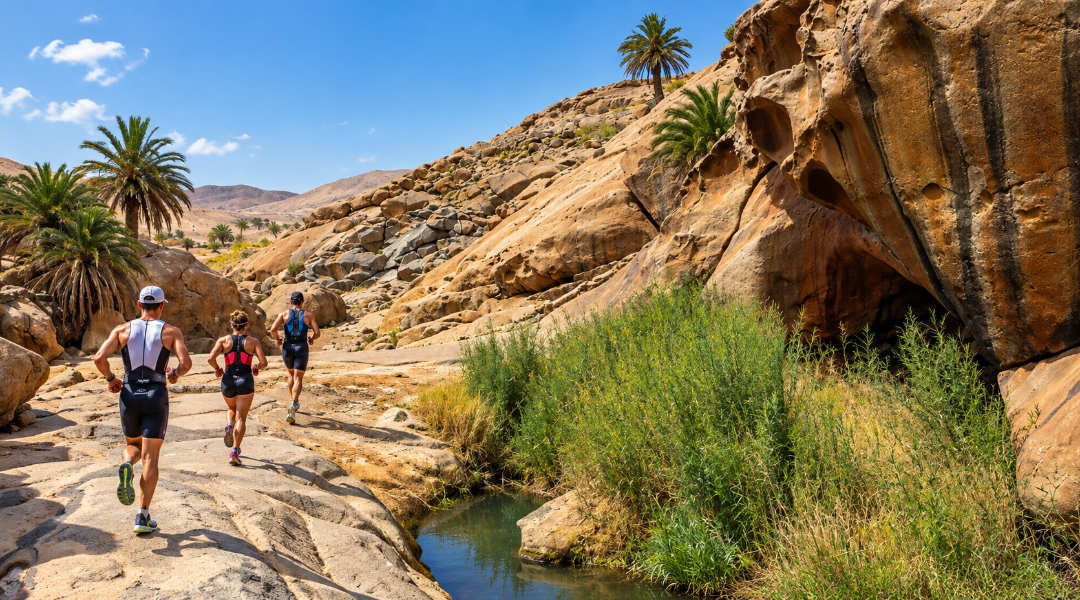
Image: AI-generated
“Choose your location based on your workout—instead of having to adjust your workout to the location later.”
Cycling training on Fuerteventura: the wind is part of the route
Open landscapes and long roads make the road bike an obvious part of your training camp. However, you should never judge distances by kilometres alone.

Image: AI-generated
The trade winds typical of Fuerteventura often blow from northerly directions. This can significantly change how demanding a ride is.
The way out feels relaxed – and on the way back, two hours of headwind are suddenly waiting for you.

Image: AI-generated
Before going on longer rides, you should therefore consider the following:
- Distance and elevation gain
- Wind speed and direction
- Planned intensity
- Workload from the previous days
- Food and fluids
- Return route and possible shortcuts
Plan based on the expected total workload—not on a specific number of kilometers you absolutely want to reach.
Specific cycling routes and regions
A good reference for longer rides is the island’s official cycling route from Puerto del Rosario via Corralejo, Villaverde, La Oliva and the interior all the way to Morro Jable. At around 146 kilometres, the full route is a true long-distance ride and explicitly intended for well-trained cyclists.
Of course, you don’t have to ride the entire route. Individual sections are often more interesting for a training camp:
- Corralejo – Villaverde – La Oliva: open landscape, good for longer cycling blocks in the north.
- Betancuria – Pájara: much hillier and interesting when elevation gain is meant to be part of the session.
- Pájara – La Pared – towards Jandía: suitable for longer endurance sessions in the south.
- Las Playitas and surroundings
Plan your loop courses and turning-point routes so that, as the wind picks up, you don’t end up facing the toughest stretch during the last third of the course.
.

Running training: first the session, then the route
Asphalt, wide paths, coastal trails, sand and volcanic ground: when it comes to running, Fuerteventura shows its full range.

In the north, for example, you can use the landscape around Corralejo, Lajares, Villaverde and La Oliva. For more demanding trail sessions, the interior around Betancuria offers considerably more elevation gain.
Little elevation gain doesn’t automatically mean an easy run. Sand challenges your muscles differently than asphalt. Rocky or technical terrain also changes pace and load significantly.
So choose the session first – and then the route.

Image: AI-generated
Easy endurance run:
Firm, well-managed terrain where you can accurately control your effort and pace.

Image: AI-generated
Strength or trail training session:
Sand, hills, and more challenging terrain can be intentionally included.

Image: AI-generated
Recovery run:
Short, easy and simple. Not every run has to become a little Fuerteventura adventure.
This separation is especially important during training camp. If every session is long, unusual, or demanding, the week can quickly become tougher than planned.
Swim Training: Pool or Atlantic?
Both have their place—but not for the same session.
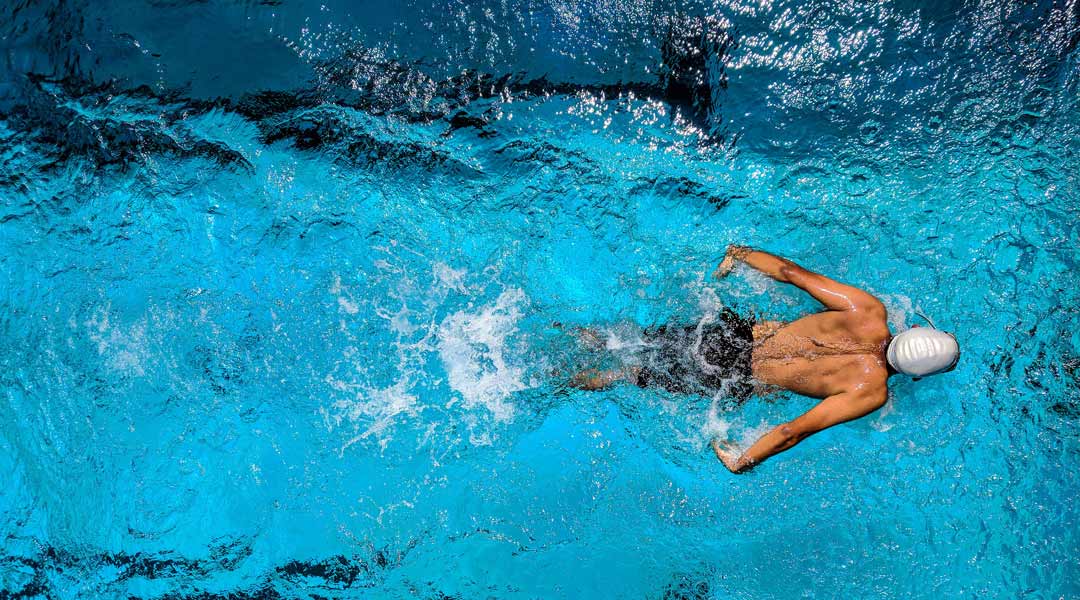
For precise intervals, technique training, and controllable intensity, a pool is the easier choice. For orientation, the feel of open water, and triathlon-specific practice, the Atlantic can be a good option.

Open-Water Training in the Atlantic
The Atlantic Ocean is not a swimming pool.
Wind, waves, currents, visibility, and entry and exit conditions all determine whether a planned session is practical and safe. A bay that looks calm from the beach does not necessarily offer suitable training conditions in the water.
The training plan tells you what you want to work on. The conditions determine whether you’ll go into the ocean to do it.
If you can’t reliably assess the local conditions, guided or organized open-water training is the better choice.
Moving a session to the pool isn’t a wasted training day. Sometimes that’s actually the better training decision.
Pools for swimming training on Fuerteventura
For structured swim training, these options are particularly interesting:
Las Playitas:
The Playitas Resort’s heated 50-meter pool has eight lanes and is specifically equipped for training and competition. The resort also offers swimming lessons and open-water activities.

Corralejo:
The municipality of La Oliva runs an Olympic-size outdoor Piscina Municipal in Corralejo.

La Oliva:
There is also a municipal heated and indoor swimming pool here.
For municipal facilities, you should check before your trip to see if and when public lap swimming is available.
Gyms, Strength Training, and Other Training Options
Strength training and mobility exercises are often overlooked when planning a triathlon training camp. If they’re an integral part of your plan, it’s worth checking out the facilities before booking your accommodations.

Las Playitas is once again particularly extensive. The gym there covers about 700 square meters and features treadmills, ergometers, rowing machines, ski ergs, strength training machines, and a free-weight area. The offerings are complemented by, among other things, a WOD Box, an outdoor gym, and additional training areas.
This makes a difference if, for example, you want to plan a quick strength session, mobility work, or a backup workout that isn’t affected by the weather.
For other locations, don’t just check if Google Maps shows a “gym” somewhere. For a training camp, opening hours, daily access, free weights, cardio equipment, and the distance from your lodging are much more important.
We can recommend the following gyms in the north
Relaxed training in Lajares and Corralejo
Feel Fit Gym in Corralejo
Lajares Gym
Crossfit Fuerte Lajares
How to Find the Right Location for Your Training Camp
Before you book accommodations, go over your training plan in practical terms.

Image: AI-generated
- Where are some good starting points for road bike routes?
- What types of running surfaces are within easy reach?
- Do you need a 25- or 50-meter pool?
- Can you actually use the pool during your training hours?
- Do you want to train in open water regularly?
- Do you need a gym and strength training area?
- Is there bike rental or technical support available?
- Can you store your own bike safely?
- How long is the daily commute between your accommodations and the training facility?
- Do you want to have time for surfing in addition to your triathlon training?
Short distances within the training camp itself are a training aid. The less time you spend traveling between the bike, the pool, the running course, and your accommodations, the more time you have for recovery.
When is the best time for triathlon training on Fuerteventura?
The mild and comparatively dry climate makes Fuerteventura attractive for outdoor training for much of the year.

Still, there’s no one-size-fits-all “best time” to travel.
For your training camp, in addition to the air temperature, the most important factors are wind, water temperature, training volume, and your current training phase.
If you’re coming from a Central European winter, the practical advantage is easy to explain: it’s often easier to schedule outdoor cycling and running sessions in the mild island climate.
However, whether a specific week aligns well with your training goals depends on the actual weather.
Just before your trip, check not only the temperature and sunshine, but especially the wind direction and wind speed. For long bike rides, this can be more important than a difference of a few degrees.

Image: AI-generated
Here’s what a typical training week might look like
Having more free time doesn’t mean that every free hour has to be spent training.
|
Tag |
Focus |
Optional |
|
1 |
Leisurely bike ride |
short warm-up |
|
2 |
Swimming |
Running Training |
|
3 |
Long bike ride |
Mobility |
|
4 |
Recovery |
Easy swimming |
|
5 |
Cycling Training |
Short interval run |
|
6 |
Longer endurance session |
light recovery run |
|
7 |
Quiet session or break |
– |
This is intentionally not a set training plan. The volume and intensity must be tailored to your performance level, your race distance, your training phase, and your recovery.
The order of the sessions can also be adjusted. If strong winds make a long bike ride unnecessarily tough or the Atlantic Ocean doesn’t allow for a productive swim workout, it’s better to swap sessions rather than stubbornly sticking to the plan.
Above all, having more time to train means having more opportunities to combine effective workouts with proper recovery.

Image: AI-generated
5 Common Mistakes at Triathlon Training Camps
1. Go full throttle right from the start on the first day
Travel, unfamiliar surroundings, and an increased training load all come into play. Start off easy and save your energy for the key workouts.
2. Underestimating the wind while cycling
80 kilometers aren’t always the same 80 kilometers. Plan your out-and-back route together and save some energy for headwinds.
3. Turn Every Run into a Trail Run
Dunes and volcanic trails are appealing. Still, for a relaxed long run, a paved path might be the better training route.
4. Make yourself go for a swim in the ocean
If the wind, waves, current, or entry and exit conditions aren’t suitable, we’ll adjust our plans. A pool, an alternative activity, or a break are better than taking unnecessary risks.
5. Viewing recovery as lost training time
Progress requires both exertion and recovery. This is especially true when you add surfing sessions to your triathlon training.

Image: AI-generated
Packing list for triathlon training on Fuerteventura
|
Check |
Equipment List |
|
|
□ |
Road bike, triathlon bike, or reserved rental bike |
|
|
□ |
Helmet, cycling shoes, and repair kit |
|
|
□ |
Running shoes and, if necessary, trail running shoes |
|
|
□ |
Swimming goggles and swim cap |
|
|
□ |
a suitable wetsuit for open water |
|
|
□ |
Sun Protection |
|
|
□ |
Water Bottles and Sports Nutrition |
|
|
□ |
GPS watch or bike computer |
|
|
□ |
Lightweight wind layer for biking |
|
|
□ |
small first-aid kit |
|
|
□ |
Clothing for Mobility and Recovery |
If you’re traveling with your own bike, check your airline’s baggage policies well in advance and find out where you can safely store your bike at your destination.
When renting a bike, it’s not just the model and frame size that matter. Also check the pedal system, gear ratio, adjustment options, and technical support.
Triathlon and surfing: do they go together?
Yes – as long as you plan surfing as part of your overall training load.
Paddling, take-offs and working in the water put additional strain on your body. After a longer surf session, the quality session planned for the afternoon may therefore make less sense than it did on your training plan that morning.

Surfing counts as training load – even if it doesn’t feel like classic training.
If you want to combine triathlon with a surf holiday on Fuerteventura, don’t plan either sport as if the other didn’t exist.
If you’re traveling with your own bike, check your airline’s baggage policies well in advance and find out where you can safely store your bike at your destination.
When renting a bike, it’s not just the model and frame size that matter. Also check the pedal system, gear ratio, adjustment options, and technical support.

That doesn’t mean you have to optimize every minute, though.
Sometimes it’s okay to let the bike rest. Sometimes open water can just become the sea.
After all, you’re not on an Atlantic island just to rack up kilometers.
Frequently asked questions about triathlon training on Fuerteventura
Is Fuerteventura a good place for a triathlon training camp?
Yes. The island offers cycling, a variety of running surfaces, swimming pools, and—when conditions are right—open-water swimming. It’s especially convenient to stay somewhere that puts you within easy reach of several training options without having to travel far.
Where can I train in a 50-meter pool on Fuerteventura?
Playitas Resort has a heated 50-metre pool with eight lanes. In Corralejo, the municipality of La Oliva also runs an Olympic-size outdoor pool. Check access and training times in advance in each case.
Which region is particularly well-suited for a structured triathlon training camp?
Las Playitas offers a 50-metre pool, gym, cycle centre, running routes and other sports facilities all in one compact area. The north around Corralejo, La Oliva and Lajares, on the other hand, is interesting if you want to combine training more closely with trails and surfing.
Is Fuerteventura flat?
No. In addition to flatter and undulating sections, there is significantly more challenging terrain in the island’s interior. Especially around Betancuria and Pájara, you can incorporate elevation gain into your cycling or running workouts.
Is Fuerteventura a good place to ride a road bike?
Yes. In addition to distance and elevation gain, be sure to take wind direction and wind speed into account. On open roads, the wind can significantly affect the actual difficulty of a ride.
Is Fuerteventura a good place to go running?
Yes. Depending on the region, you’ll find asphalt, paved paths, sand, and more challenging volcanic trails. Choose the terrain that’s right for the session, not just the most spectacular route.
Can I train in the ocean on Fuerteventura?
Under the right conditions, yes. Wind, waves, currents, visibility, and entry and exit points must all be taken into account. If you can’t reliably assess the conditions, supervised open-water training is the better choice.
Are there gyms for strength training?
Yes. The Playitas Resort offers particularly extensive workout options, including a gym that’s about 700 square meters in size, a free-weight and cardio area, and additional workout spaces. For other accommodations and gyms, you should check the equipment and daily access options in advance.
Can I combine triathlon training with a surfing vacation?
Yes. However, treat planing as an additional physical challenge and adjust the duration and intensity of your other workouts accordingly.

Training with a sea view – but with a plan
Fuerteventura gives you plenty of room for a varied triathlon training camp.
On the bike, wind can be just as decisive as elevation gain. When running, you can choose between manageable paths, sand and volcanic trails. For swimming, there are pools depending on your location – and the Atlantic, when conditions are right.
That’s why the biggest difference often comes down to choosing your base: a good location saves transfers and makes it easier to combine training, food and recovery.
And then there’s one more thing that doesn’t need to be in any training plan:
the sea.
Combine triathlon & surfing
If you want to combine your training camp with a few days of surfing or get to know Fuerteventura better, you’ll find more tips about the island in the FreshSurf Fuerteventura Guide.
EXTERNAL SOURCES
Official Fuerteventura tourism website – cycling route through Fuerteventura
https://www.visitfuerteventura.com/en/cycling/fuerteventura/cycle-route-in-fuerteventura/
Official Fuerteventura tourism website – Betancuria Trail
https://www.visitfuerteventura.com/de/berglaufstrecken/fuerteventura/trail-betancuria/
Municipality of La Oliva – municipal sports facilities and swimming pools
https://laoliva.es/oficinas-municipales
Playitas Resort – Triathlon and Training Facilities
https://www.playitas.net/de/sport/triathlon
Playitas Resort – Olympic-Size Pool
https://www.playitas.net/de/sportanlage/olympischer-pool
Playitas Resort – Gym and Fitness
https://www.playitas.net/de/sportanlage/gym