



How to laminate your surfboard
Shape your surfboard: part 4
You have chosen the right surfboard for you (part 1), got the tools you need (part 2) ready and shaped your blank into a surfboard (part 3). Now we’ll show you how to laminate your surfboard before you set the fin plugs (part 5) and design your individual graphic (part 6)!
Get started laminating your surfboard!
Laminating makes your board waterproof and gives it the stability it needs. Laminating is also called glassing and is nothing other than the outer shell of the board. It consists of several layers, prevents the board from soaking up water and protects it from knocks. You have to decide how many layers your board needs. Depending on the board length and your needs, you can apply one to a maximum of three layers. But bear in mind that with every additional layer your board becomes not only more impact-resistant but also heavier.
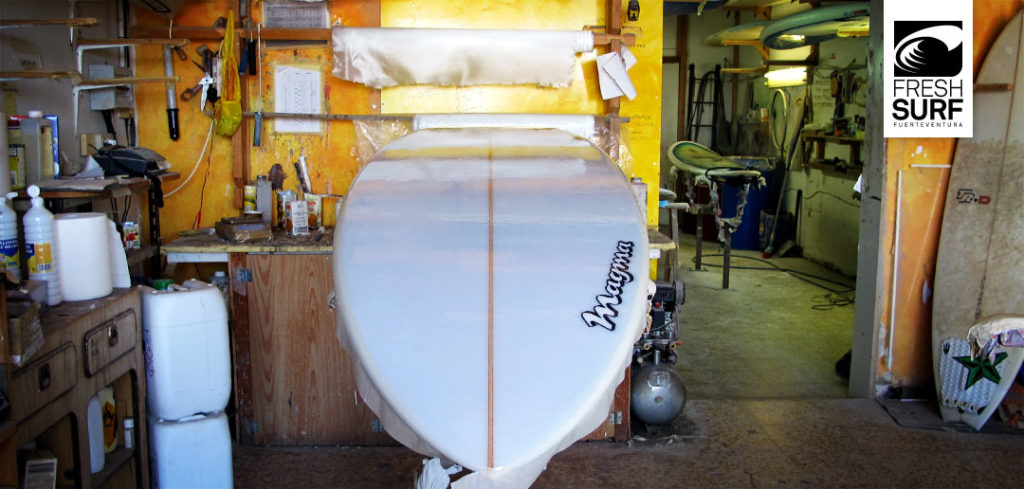
For glassing, place the board bottom up again and remove all dust and dirt. Then roll out the fibreglass cloth on top and let it overhang at the ends by at least 2–3 cm so you can wrap it around the rails. Once everything is prepared, you’ve placed any stickers or similar under the fibreglass cloth and put on your respirator mask, you can mix the resin and the hardener and get to work.
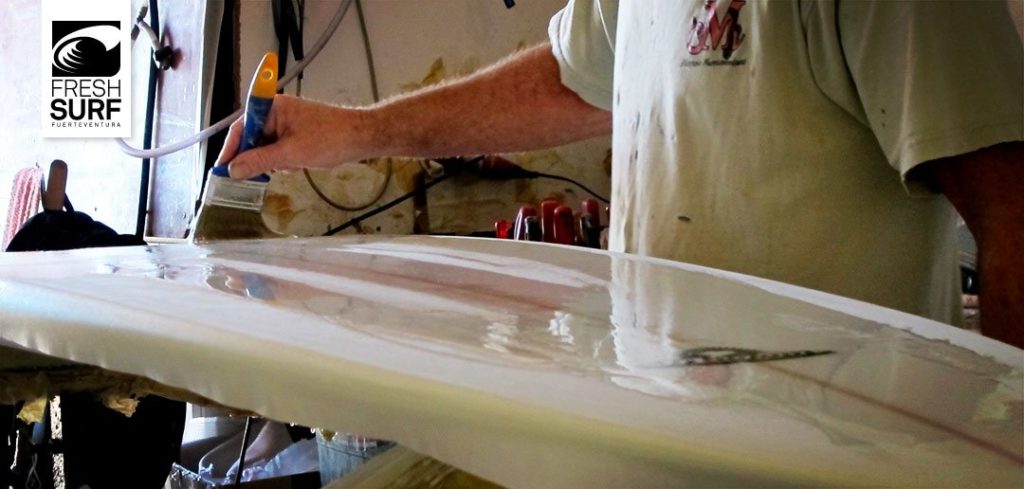
Pour the mixture along the stringer and then spread it evenly and thinly in long, continuous strokes over the surfboard. The resin may also run down the overhanging parts. Once you’ve spread the resin well on the board, you can wrap the rails. To do this, simply use the squeegee to smooth the overhanging material around the edges and add a little more resin if not everything is evenly covered yet.
Now you can let the board cure. The resin has to dry for at least 6 hours before you can continue working.
How to sand the laplines
As the next step, turn the board over and sand off all unevenness. The lapline is the part where the fibreglass cloth ends on the foam. Before you do the deck, you should sand the lapline well so that there’s a smooth transition from foam to board without edges. Make sure you only sand the fibreglass cloth and don’t work into the foam, damaging the core!
