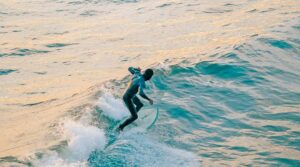

After a successful first day of the surf course on Fuerteventura, the balancing act on the surfboard is imminent. The second day of surfing is more about the basic movement sequence and the transition from the lying position to standing on the surfboard.
In this phase of learning to surf, it is important to recognize the central movements with the characteristics and to be able to implement them roughly. So on this day, you will gain your first experience of the take-off in rough form and gradually execute the movement in a more diligent and coordinated manner.
At our surf school in El Cotillo, we use the 3-step technique for optimal take-off:
- Push-up with slight rotation of the hips
- Rear foot to front knee
- Front foot forward
You can find out which leg is your supporting leg, i.e. whether you are regular or goofy, with a few simple tests. For example, you can take the supporting leg from your ball sports or ask a friend to nudge you forward. The leg you use to lunge forward is then ultimately the front leg on the surfboard 🙂
Whether you master the balancing act on the sorftboard depends in most cases on the position of the front foot during take-off. You can practice this in advance and here with us in El Cotillo when carving or longboarding, as stability is created with the center of gravity on the front foot both when skating and surfing. So grab a board and practise the perfect stance!
Using your arms to paddle the shaft correctly
Paddling for a surfer is like running for a jogger, you simply can’t move without it. Paddling is therefore necessary to move through the water and to generate enough speed for an optimal take-off. A slower paddle speed allows you to paddle out into the line-up and hold your position in the current. The faster speed allows you to take the incoming wave with maximum power.
The paddle position on the surfboard is first practiced with the surf coaches on the beach. The decisive factor here is:
- the position on the surfboard: further forward towards the nose of the board there is a risk of nose diving and too far back the board is too steep in the water and slows you down unnecessarily in the planing phase.
- good body tension: the abdomen, hips and lower legs adhere to the board and the upper body and head are raised, so the body is in good contact with the surfboard and the paddle stroke can be performed more easily.
The ideal position for paddling is now used to execute the movement. The arm movement is similar to crawling and essentially consists of a dip, pull and push phase with subsequent forward movement of the arm. A wave is now simulated with the help of the surf instructors: you start with a powerful, high-frequency paddling technique, a wave comes in, the water splashes at the rails, the board accelerates and grabs the surfboard. Now is the perfect time for the take-off!
A Beginner's Guide – Part 1

A Beginner's Guide - Part 2

A Beginner's Guide – Part 3