After learning the basics and practising hard during the first two days of the beginner’s surf course in Fuerteventura, the third day of surfing focuses more on the finer points and manoeuvring in the water.
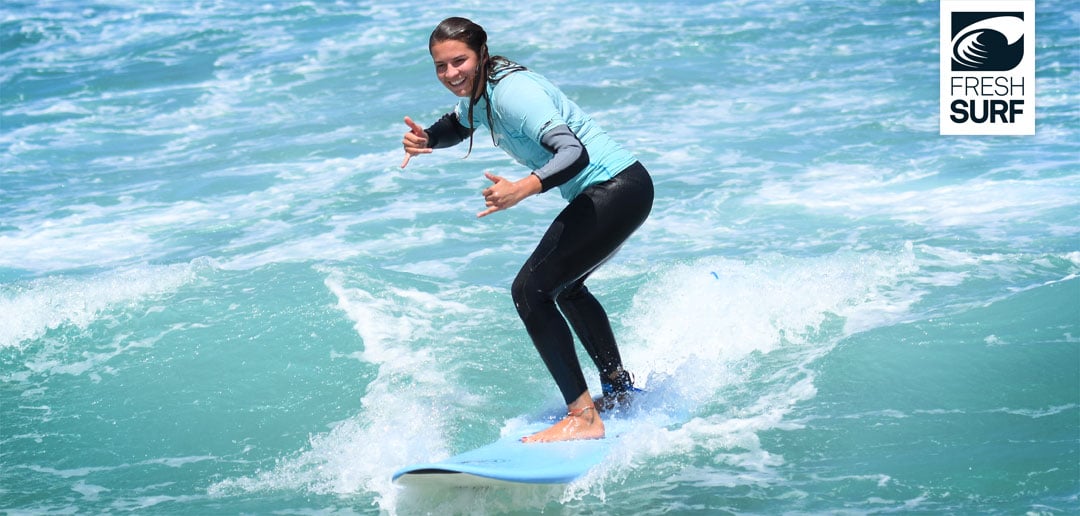
You’re already nailing the take-off and timing of the wave, and now the real surfing begins! This means you’re now riding along the green wave. The direction you take initially depends on the direction the wave breaks. To change direction, look in the direction you want to go, actively bend your knees slightly, shift your weight onto your back leg and lean into the turn. As you ride the wave, observe how it behaves and where you are on the wave. It’s best to always surf close to the breaking edge of the wave. Your first turns will happen when you repeatedly steer the surfboard towards the face of the wave.
Riding whitewater waves on a softboard
Je weiter ihr mit der Take-off-Technik vorankommt und immer mehr Weißwasserwellen surfen könnt, desto mehr werdet ihr euch RIchtung grüne Wellen heranwagen. Beim Hinauspaddeln werdet ihr auf kurz oder lang nicht darum herum kommen, Weißwasserwellen und kleine Wellen mit dem Surfbrett zu überwinden. Und wie geht das – natürlich mit der perfekten Technik 🙂
You can ride small waves on your surfboard with a good push-up and plenty of body tension, pressing the nose of the board under the white water. However, this technique isn’t ideal for larger, more powerful waves. In conditions with stronger breaking waves, the so-called ‘turtle roll’ is used, where you roll into the water with the surfboard and pull yourself back onto the board into the paddling position. You should, of course, practise this technique first on land and then in calm water to gradually get used to the sequence of movements.
The right steps towards the intermediate course
By the end of your beginner’s surf course here in El Cotillo, you’ll have caught the surfing bug – so what next? Let’s keep going! And let’s do it by taking the right steps towards the advanced beginner’s course. Our intermediate students usually head out to the reef here at our surf school. The prior experience you’ll need for the reef surf course isn’t just mastering the take-off, but also a certain level of fitness to be able to paddle for long periods and with endurance, as well as riding the wave at an angle (frontside & backside). Further requirements for surfing at the new spot are knowledge of the right-of-way rules and, as always, the safety rules! Feel free to check out our blog, where we take a close look at both of these topics.

A Beginner’s Guide – Part 1

A Beginner's Guide - Part 2

A Beginner’s Guide – Part 3