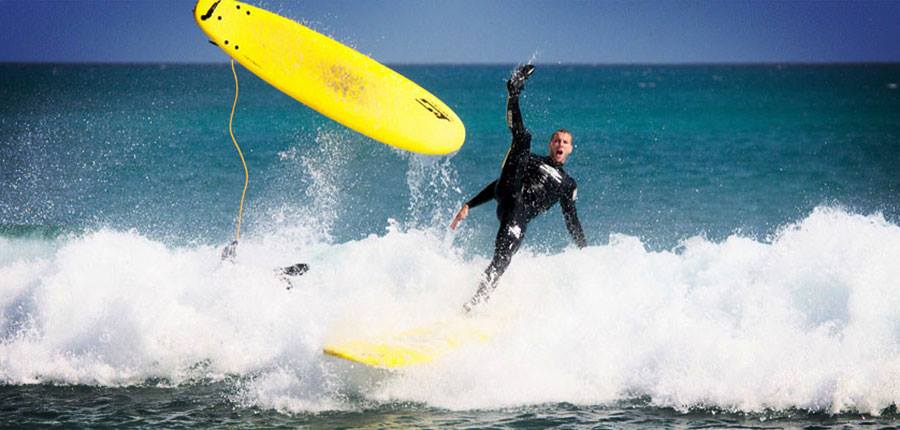

Surfing looks easy—but how does it feel as a beginner?
You may be familiar with surfing from movies, Instagram, or your last vacation, when you watched enviously from the beach. Everyone seems to stand up effortlessly, glide casually toward the shore, grin at the camera—and you wonder:
“How hard can it be? I’m reasonably athletic…”
The honest answer: surfing isn’t difficult because you’re “too unathletic” – it’s because it’s a complex sport that challenges your body, mind, and the sea all at once. And that’s exactly where a good beginner surfing course comes in.

In this guide, we take you, as a beginner surfer, through your first day of surfing at the FreshSurf surf camp on Fuerteventura: from getting to know each other at Cotillo Beach, to softboards (yes, the “giant boards” are intentional), to understanding currents, wind, and waves.
You will learn:

What you can expect as a beginner surfer at FreshSurf
You arrive at the surf camp as a beginner—perhaps alone, perhaps with your partner, girlfriend, or crew. At FreshSurf, that’s exactly what we’re here for: teaching surfing in small groups, with lots of patience, humor, and honest feedback.
In our surfing course for beginners on Fuerteventura, you will learn:
-
the basics of safety at sea
-
how to handle a softboard
-
how to paddle correctly and stand up (take-off)
-
how to surf the first white water waves
-
how you assess wind, waves, and currents
The course is structured so that after a few days you will have mastered the basics and can continue practicing on your own—whether at our surf camp or elsewhere in the world.

Why you should start on a “giant” softboard as a beginner surfer
Have you seen pictures of pros riding super narrow, short boards?
If you go into the water with it as a beginner surfer, frustration is practically inevitable.
A good beginner board is long, wide, and has a lot of volume!
Why?
Because it gives you stability, more buoyancy, and thus significantly more waves—and that’s exactly what you need at the beginning: lots of repetitions, lots of attempts, lots of moments of success.

The advantages of softboards in beginner courses
We deliberately use softboards in our beginner courses because they:
- make paddling easier for you
- give you more time and stability when getting up
- makes it easy to catch waves with little power
- Make falls significantly gentler (thanks to soft surface and rubber fins)
- reduce the risk of injury to yourself and others in the water
The more volume, the more fun—and the faster you learn.
Why should beginner surfers surf with a softboard?
If you want to delve deeper into the topic, we recommend our blog article,
where you will find even more information about board sizes, safety, durability, and switching to a hardboard later on.

Your first day of surfing with us – step by step
To help you get a better idea of what to expect, let’s go through your first day of surfing lessons at Cotillo Beach together.

Arrival and getting acquainted
- The meeting point is the surf shop in El Cotillo.
- You will get to know your surf instructors and your group.
- We will review your level, experience, and preferences for the week together.
It is important to us that you feel safe, seen, and not “left behind.”

Material check
You get:
- Wetsuit in the right size
- Softboard that suits your height, weight, and skill level
- Leash and any other safety information
Your coach explains directly to you:
- How to carry your board and leash correctly
- how you enter the water with your board
- what you shouldn’t do (e.g., throwing your board)

Warm-up & theory on the beach
Before you go into the water, there is:
- A short warm-up (joints, shoulders, core—no boot camp hell)
- an introduction to safety and rules of conduct
- first theory:
- Wie entsteht eine Welle?
- What ist white water?
- How do you position yourself correctly on the board?
Here you can practice your take-off on the sand—that is, the sequence of movements from lying down to standing up.

First waves in white water
Then it’s time to get in the water—the white water, not the big green waves just yet.
You learn:
- to orient yourself in the sea
- to control your board iin the white water
- approaching the first waves while lying down
- standing in the white water for the first take-offs
Every beginning is difficult—even as a beginner surfer
Yes, you will fall down often.
No, that doesn’t mean you’re “bad.”
Every wave is feedback—and your coach is by your side the whole time, giving personalized tips and correcting small details that make a big difference.

Understanding the sea: currents, wind, and wave forms
For many beginner surfers, the ocean is a completely new environment at first. It seems magical and a little intimidating at the same time.
That’s why we teach you to “read” the sea at an early stage.
Currents (lateral currents & undercurrents)
You learn:
- how to recognize currents from the beach
- how you can use them to your advantage (e.g., as a “lift” toward the line-up)
- how you behave when you get caught in a strong current
This knowledge is one of the most important building blocks for being able to safely go into the water later on without a surf instructor.

Warum Wind die Wellenform verändert
In the beginner course, we explain the basic difference between:
-
Offshore wind (from land towards sea):
causes waves to break cleanly, steeply, and longer—the “postcard setup.” -
Onshore wind (from the sea towards land):
flattens the waves, making them more chaotic and turbulent.
Why wind changes the wave form
More information about the influence of wind direction on waves and why this is so interesting for (aspiring) surfers.

For beginners, slightly onshore conditions can even be advantageous because the waves are softer and more forgiving—perfect for gaining your first experiences in the white water in a relaxed manner.
Before each session, we review the conditions together—this way, you’ll learn to understand swell, wind, and tides along the way.

FAQ for beginner surfers – the most common questions before the first lesson
Am I too old to start surfing?
No.
The decisive factors are your motivation, your basic health, and your willingness to give yourself time. We have had many guests who surfed their first wave in their 40s or 50s—and felt like they were 16 again.
How fit do I need to be?
You don’t have to be a marathon runner, but:
- sicher schwimmen können
- have an average level of fitness
- be willing to step outside your comfort zone a little
The rest will come automatically over the next few days.
How many days should I plan for?
Our beginner surfing course usually lasts 2–5 days, giving you enough time to learn the basics and see progress. More days = more repetition = more confidence. Remember to take a break sometimes! Experience has shown that many guests like to take a break from surfing after 2 or 3 days so they can come back refreshed and ready to go.
What equipment do I need?
You only need:
- bathing suit
- towel
- Sun protection (high SPF, preferably reef-friendly)
- bottle of water
You’ll receive a board, wetsuit & leash from us.

Your first day of surfing is just the beginning
Learning to surf as a beginner means:
- you learn to understand a completely new element
- You train your body in a natural, functional way.
- you face fears that you may have been carrying around with you for a long time
- You collect moments of success that have an impact far beyond your vacation.
At FreshSurf Surf Camp on Fuerteventura, we guide you through this process with professional coaches, clear teaching methods, and an atmosphere where you can be yourself.