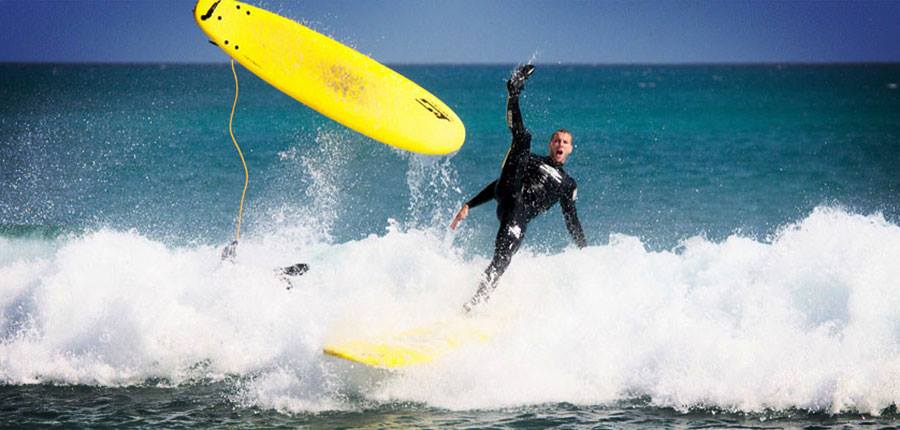
Learning to surf is a dream for many who want to experience that unique blend of adventure, nature, and athletic challenge. But how long does it actually take to successfully ride your first waves?
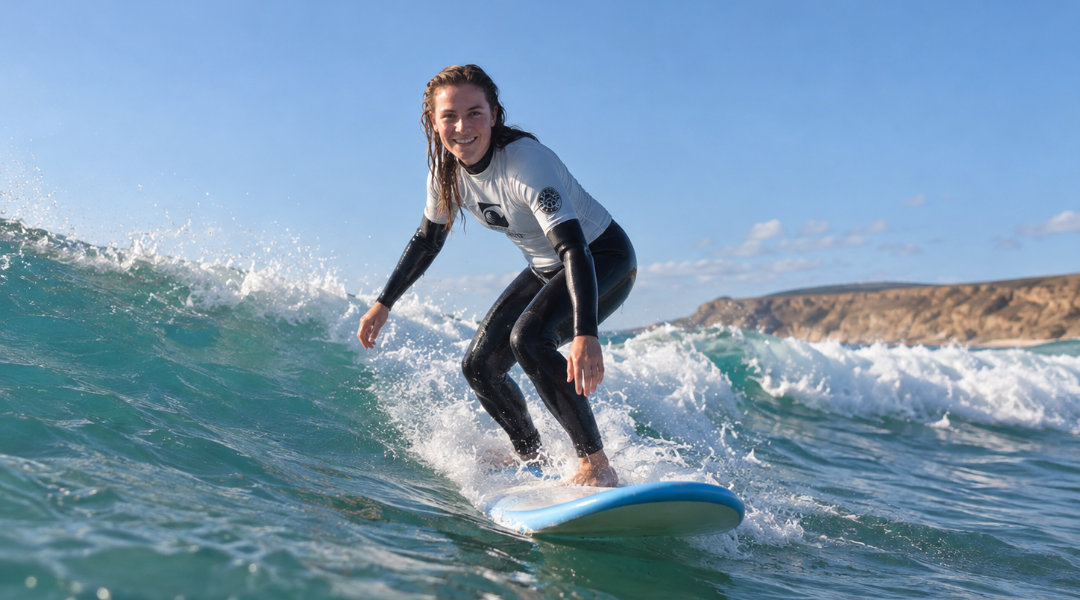
The first wave. The first takeoff. Standing on the board for the first time, gliding a few meters toward the beach.
Those first feelings of success in surfing can come surprisingly quickly.
On the other hand, it takes significantly more time before you can independently spot the right waves, catch green—that is, unbroken—waves, and find your way around the lineup with confidence.
The honest answer: You can’t learn to surf in a specific number of days. You learn it in stages.

You can learn the basics right away in your first few sessions. Independent surfing develops through repetition, a growing understanding of the ocean, and regular practice.
So the better question is:
What do you want to be able to do when you go surfing?

| Learning Phase | How to Tell If You’re Making Progress |
| First Session | You’ll learn board control, paddling, take-offs, and basic safety skills, and you’ll practice in whitewater. |
| Multiple Sessions | Timing, balance, and take-off become more familiar and easier to repeat. |
| Several days of surfing | You need less help with the basics and focus more on the waves and your position. |
| Next Learning Level | You’ll start to recognize suitable green waves on your own, paddle out to them, and surf along the wave. |
| As you gain more experience | you’ll gain a better and better understanding of the lineup, right-of-way rules, wave selection, currents, and your own limits. |
The honest answer: You can’t learn to surf in a specific number of days. You learn it in stages.

These steps don’t happen at the same pace for everyone.
Maybe you’ll master your takeoff early on, while it takes you longer to read the waves. Maybe you’ll feel comfortable on the board quickly, but paddling still takes a lot of effort.
That’s why the number of days you’ve spent surfing isn’t, on its own, a particularly good measure of how far along you are in your surfing journey.

What does “knowing how to surf” actually mean?
Standing up on a broken whitewater wave is different from picking out a green wave yourself, paddling out to it, and surfing along its open face.
And even that doesn’t automatically mean you can independently assess an unfamiliar spot.
It makes more sense to measure your progress in surfing based on specific skills.

Board Control and Takeoff
At first, you’ll learn to stay stable on the board, paddle efficiently, and control your board safely.
Then, that first random attempt at standing up will gradually turn into a repeatable takeoff: paddle, feel the wave, stand up, and continue riding steadily.
That’s exactly why repetition is so valuable.

Timing and Reading the Waves
When surfing, just moving the right way on the board isn’t enough. You also have to be in the right place at the right time.
With more time in the water, you’ll develop a feel for when to paddle, which wave suits you best, and where it’s likely to break.
This becomes especially clear during the transition from whitewater to the green wave. In the whitewater, the energy from the wave that has already broken comes toward you.

When you see a green wave, you have to decide for yourself:
- Which wave should I take?
- Where should I position myself?
- When do I start paddling?
- In which direction do I start?
Assessing the Ocean Itself
Surfing on your own means more than just standing on the board without a coach.
You also need to be able to assess whether the spot and conditions are right for your skill level. Waves, wind, tides, currents, getting in and out of the water, other surfers, and how you’re feeling that day all play a role.
This is exactly where the real transition begins—from first standing up to riding waves on your own: You’re no longer just reacting to a wave; you’re starting to understand what’s happening around you.

Really Important Questions About Surfing
Why do some people learn to surf faster than others?
Surfing involves many skills working together at the same time. That’s why two beginners rarely progress at exactly the same pace, even under similar conditions.

Consistency
Doing lots of repetitions helps you solidify your movements and timing. If there are long breaks between your sessions, you’ll often need a little time to get used to the board and the ocean again.
That’s why surfing several days in a row can be helpful: what felt unfamiliar yesterday already feels more familiar today.

Terms and Conditions
Not every session offers the same learning opportunities.
On one day, you’ll get plenty of suitable waves and can practice the same maneuver over and over again. On another day, the wind, current, or wave shape will demand your full attention.
That’s why progress in surfing rarely follows a straight path.

The Right Surfboard
A board that’s too small or too challenging can make getting started unnecessarily difficult.
For beginners, softboards with sufficient volume are a good choice because buoyancy and stability make paddling and practicing easier.
The right size depends, among other things, on your height, weight, fitness level, and riding conditions.
The best board for beginners isn’t the one that looks the coolest. It’s the one that lets you get in lots of controlled reps.

Fitness and Flexibility
Endurance, shoulder strength, core stability, and flexibility all help with paddling and standing up.
Previous athletic experience can make certain movements easier. However, it is no substitute for timing or an understanding of the waves.
Even a very fit person must learn to read the ocean.
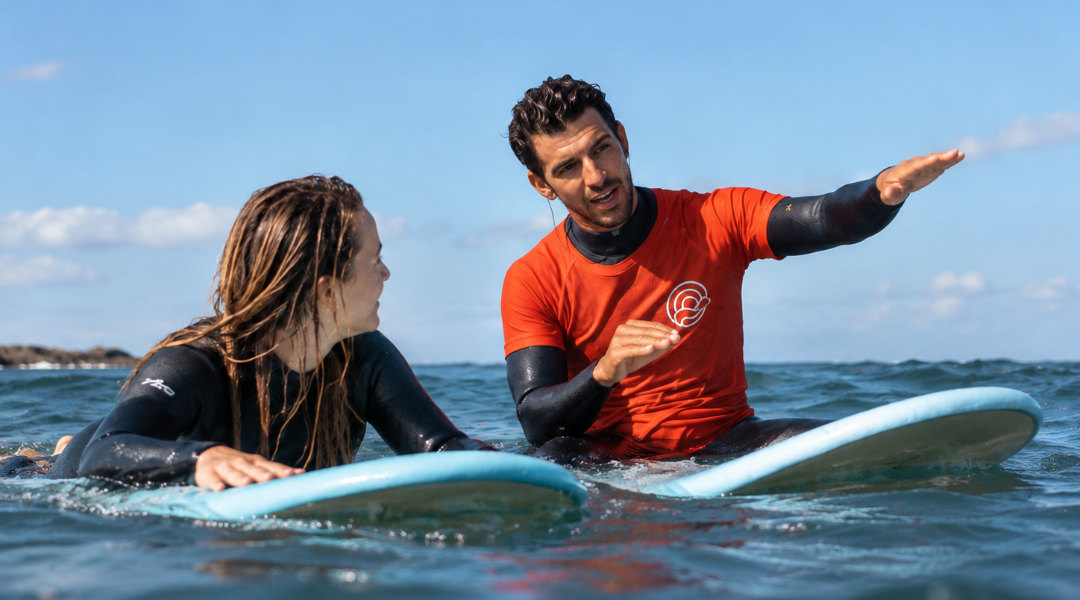
Coaching and Feedback
When surfing, it’s not always easy to figure out why an attempt didn’t work out.
Were you sitting too far back on the board? Did you paddle too late? Did you stand up too early? Were you looking in the wrong direction?
Constructive feedback helps you spot these mistakes sooner and practice in a more targeted way. That’s why a beginner’s surfing course covers not only the takeoff but also important basics about safety, waves, and conditions.
How can you tell if you’re making real progress in surfing?
It’s not just about how often you stand up.
You’ll also make progress if:
- you’re more stable on your board,
- you paddle with more precision and waste less energy,
- your takeoff becomes smoother and more reliable,
- you recognize suitable waves sooner,
- you can better assess your position in the water,
- you’ll understand why you missed a wave,
- you’ll make calmer and more deliberate decisions in the water,
- you’ll recognize when conditions are too challenging.
Progress isn’t just about knowing which wave to ride. It’s also about knowing when it’s better to skip a wave—or even an entire session.

What conditions are best for beginners to surf?
“Small waves” alone aren’t enough to make a recommendation.
Whether conditions are right for you also depends on the spot, the seabed, the wind, the tides, and the currents.
Whitewater is a good place to practice board control, paddling, take-offs, and balance without having to pick a green wave and position yourself correctly.
Even a sandy beach isn’t automatically safe. Currents can occur there as well.

So before you go into the water, check:
- Where do the waves break?
- Are there any noticeable currents?
- How do the tides affect the spot?
- Where are the entry and exit points?
- Are there rocks or other hazards?
- Are the conditions really suitable for your skill level?
- Are there lifeguards, a surf school, or experienced people on site you can ask?
If you’re not sure how to assess a spot or the conditions, stay out of the water for now and get some help.

When will you be able to surf on your own?
Not automatically after three days. And not automatically after a week, either.
A surf course can give you a good foundation. But a solid takeoff alone isn’t enough to surf on your own.

You should also understand
- how to assess a spot before the session,
- what conditions suit your skill level,
- how to control your board safely,
- what right-of-way rules apply in the lineup,
- how to interact safely with other surfers,
- how to handle currents,
- when it’s better to call it a day or not even start a session.
Technique is only one part of surfing. Safety, understanding the waves, and making good decisions are just as important.
How can you learn to surf faster?
Don’t try to rush through the learning stages. Instead, make sure you get as many good repetitions as possible.

- Use a board that’s big enough and sturdy. A beginner-friendly board will help you catch more waves and practice more often.
- Surf regularly. Consistency helps solidify your movements and timing.
- Focus on one thing at a time. For example, work on your paddling position first, then your takeoff, and later your wave selection.
- Get feedback. Otherwise, small technical mistakes can go unnoticed for many sessions.
- Watch the ocean. From the beach, observe where waves form, break, and how other surfers position themselves.
- Compare yourself to your last session, not to others. Different circumstances and conditions make direct comparisons unhelpful.
In surfing, the supposed detour through solid fundamentals is often the fastest route.

Learning to surf also means missing waves
You’ll paddle too late. Stand up too early. Fall off your board. Paddle perfectly toward a wave and still miss it. That’s not just part of the learning process. That is the learning process.

That’s why a good session isn’t necessarily the one where you stayed on the board the longest.
Maybe you’ve finally figured out where you need to position yourself. Spotted a good wave on your own for the first time. Or decided in time not to catch a wave.
That, too, is progress.
And eventually, that one moment comes: You paddle, feel the wave accelerate your board, stand up—and suddenly, for a few seconds, everything clicks.
It’s pretty hard to wipe that grin off your face afterward.
Learn to Surf with Instruction
If you’d like to take your first steps in surfing with an instructor, check out FreshSurf for more information on learning to surf and beginner surf lessons in Fuerteventura.
FAQ: How long does it take to learn to surf?
Can I learn to surf in a day?
You can learn the basics of surfing and try your first takeoffs as early as your first session. But surfing waves on your own involves much more than just standing up on the board once.
How many hours of surfing do I need as a beginner?
There is no one-size-fits-all number. Training frequency, conditions, your board, fitness level, coaching, and your learning goals all influence your progress. Therefore, focus more on your own abilities than on a specific number of hours.
Will I be able to surf after a week?
After several days of surfing, you’ll likely feel much more comfortable with paddling, takeoffs, board control, and timing. Whether you’ll be able to surf green waves on your own after that depends on your individual progress and the conditions.
Is wave riding the same as surfing?
In the context of sports, “surfing” and “wave riding” are usually used interchangeably. This refers to riding a wave on a surfboard. In everyday language, “surfing” is by far the more common term today.
Which is harder: whitewater or green waves?
Green waves require more independence. You have to recognize a suitable wave, position yourself correctly, paddle toward it, and time your takeoff just right. In whitewater, you can practice many of the basics more easily at first.
Do I need to be in particularly good shape to learn how to surf?
No. Stamina, flexibility, and core strength help, but you don’t have to be a competitive athlete. Being able to swim safely and feeling comfortable in the water are important prerequisites. If you’re not very athletic, learning to surf could be a big challenge for you.
Can I learn to surf on my own?
You can develop many skills through practice. Especially in the beginning, professional surf lessons help you get a handle on technique, safety, and understanding waves and currents. Before you surf on your own, you should be able to reliably assess the conditions and your own limits.
How long does it take to learn to read waves?
There is no set timeframe for this. Learning to read waves comes with experience and careful observation. The key is to constantly compare your assessment with how the wave actually plays out.
When should I avoid catching a wave?
If someone else already has the right of way, if you might endanger others, if you can’t safely assess the situation, or if the wave is beyond your abilities, it’s best to let them go first.

Conclusion on Learning to Surf: So How Long Does It Really Take?
The first successes in surfing can come very early on. Surfing independently and safely, on the other hand, is a longer learning process.
So don’t measure your progress just in days or hours of surfing.
Instead, ask yourself: Am I in better control of my board? Do I understand the waves better? Am I making safer decisions? Am I catching waves more effectively?
If you find yourself answering “yes” more and more often, you’ve made more progress than you did in your last session.
And maybe that’s exactly one of the reasons why surfing stays exciting for so long: even after you’ve ridden your first proper wave, the learning isn’t over.
There’s just another one waiting out there.