Wave generation
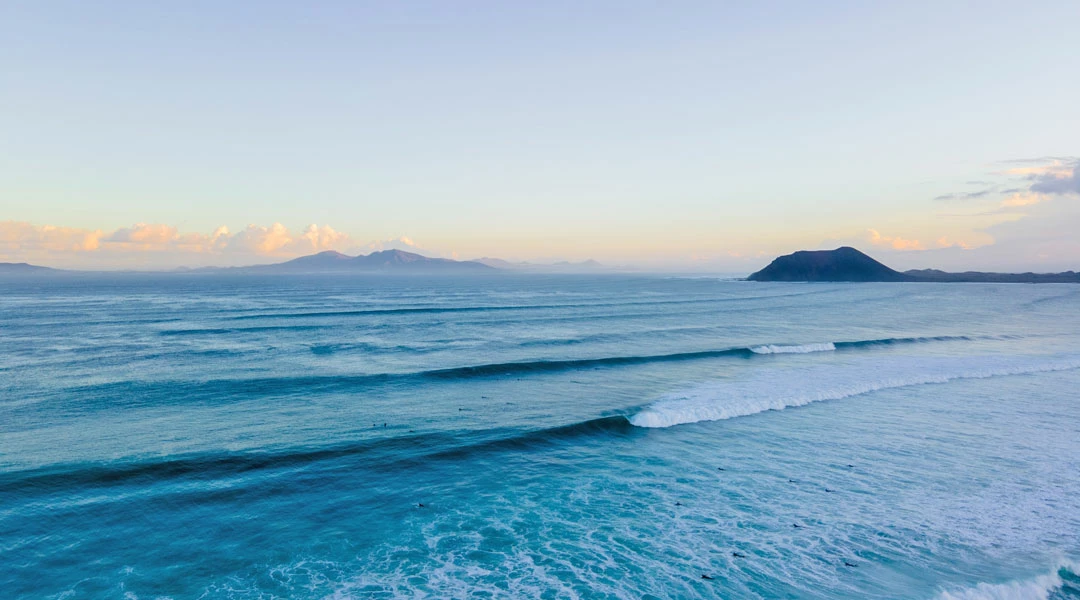
The formation of waves always follows the same pattern. Whether in Europe, North or South America, Africa, Asia, Australia or even just in the Mediterranean or the North Sea, waves behave according to certain guidelines and are formed, yes, how do waves actually form?
On this page, we would like to introduce you to the topic of wave science and explain how beaches, wind and currents affect the formation of waves and how everything is connected. You will also find tips on what you should look out for. How waves are created depends on many factors – there are also many things that influence the breaking of the wave – such as the subsoil, tides, prevailing wind, etc. – We explain all these factors in this article.
If you don’t feel like reading too much, take a look at the video about the physics behind the wave!
How waves form
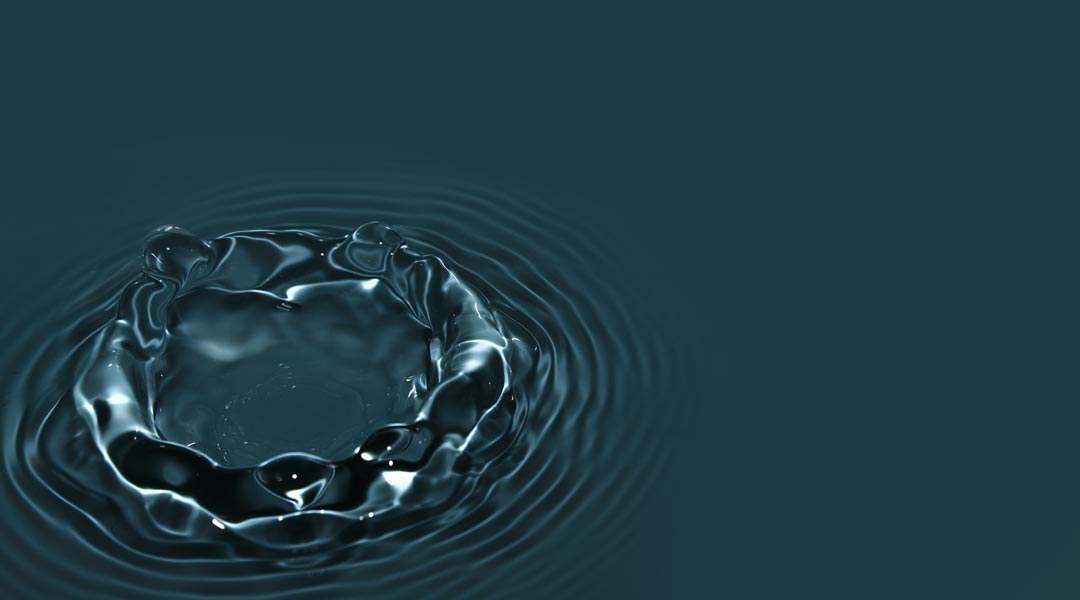
As already mentioned, there are various factors that are responsible for the formation of waves. These factors play a major role in wave science. The main cause of waves. Waves are created somewhere on the open ocean by very strong winds that cause the water surface to become turbulent. So when the wind blows over the water, friction creates waves – the wind transfers its energy to the water. The friction sets individual water particles in motion, which in turn set other water particles in motion. In terms of the open sea, this means that vast quantities of water particles are set in motion in a very short time, creating a great dynamic. On a lake, which, as we know, does not usually have such a large surface area, the waves are correspondingly smaller. The stronger and longer the wind blows and the larger the area over which the wind blows, the larger the waves will be.
Wave formation using the example of a puddle
Every one of you has seen a puddle into which the wind drives, creating small eddies and pushing them away in the direction of the wind. Depending on the duration, strength and continuity in a certain wind direction, these turbulences continue to build up and a so-called wind sea is created with disordered wave crests and troughs that are pushed out of the storm area in the corresponding wind direction. This can result in wave crests up to 60 meters high, which can not only break the neck of a small nutshell but also wipe out a large oil tanker.
The wind then drives the wave forward and the so-called wave crest is created. Gravity then pulls it back into the wave trough before the next wave crest forms and breaks again at the crest. When the wave begins to break, the first whitecaps appear. For some people, it may seem as if the water is moving with the wave, but this is not the case. Instead, the water remains in the same place and only the wave itself propagates over the surface of the sea. This means that only new water particles are actually pushed along.
When this wind sea then leaves the storm’s area of influence days later, the Earth’s gravity is responsible for the energy brought in by the wind returning to normal and sorting itself out. The wind sea leaves the area of influence (fetch) and sorts itself, i.e. the wind energy returns to sea level and shifts to so-called orbital rollers, which are located under the swell mounds.
Wave formation expressed in more physical terms
The mechanism of wave formation by wind is the Kelvin-Helmholtz instability. A distinction must be made between the influencing variables in the area where the swell is generated:
- thefetch F = distance of the wind’s effect on the water surface,
- the wind speed U and
- the wind duration as the so-called maturing time {\displaystyle D_{\mathrm {min} }} of the swell.

This is a process that takes several days, so waves that are generated far out on the open ocean are better sorted than waves that are generated close to the coast. It should be noted here that in a swell no water transport takes place, but the energy continues in a so-called orbital path. For example, if you place a cork on the surface of the water in the open sea without wind, it will not move forwards or backwards, it will only move up and down.
Wave formation – The swell hill or swell
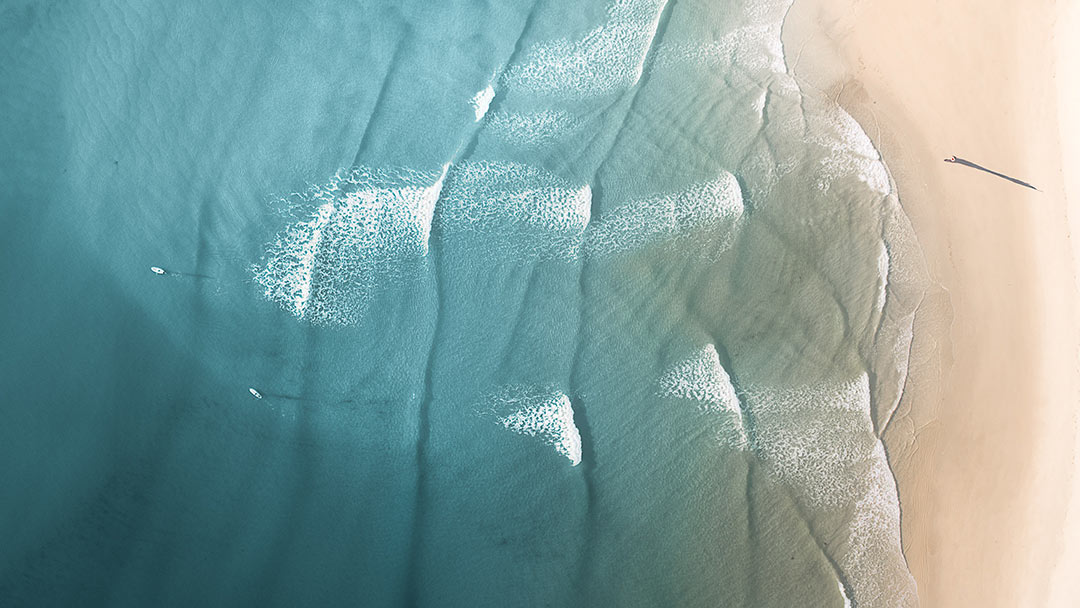
The swell mounds now travel through the ocean due to the wind energy, creating so-called swell trains (sets) based on physical laws. Larger swell mounds have a higher travel speed and a higher energy potential than smaller ones and have a higher frequency.
The waves are now sorted by superimposed frequencies and areas with pauses (set pause) and areas with waves (set) are formed. This creates swell trains with a certain number of waves. The whole principle works in a similar way to cycling: the first rider pedals, the others ride in the slipstream and then the riders switch and form groups.
Wave formation – The wave for surfing is created
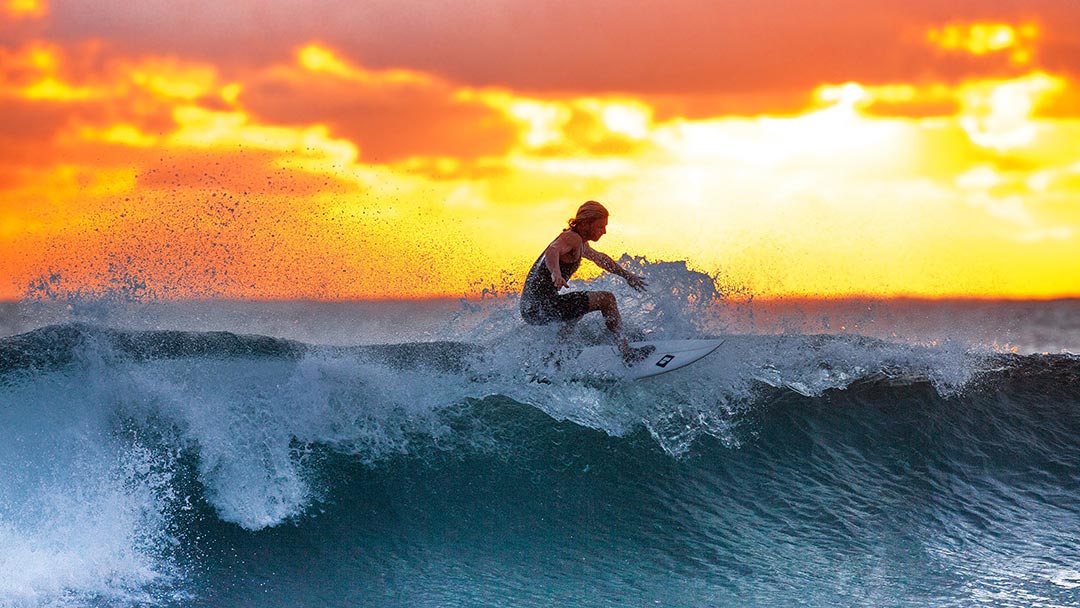
After a certain time, these swell mounds then meet our continental shelf, the distance between the orbital rollers and the subsurface becomes smaller until they touch the ground. As the orbital rollers are energy, they are pushed upwards and the further the swell mound runs towards the beach, the more it is built up (steeper). There comes a point at which the swell mound has reached its maximum height. Due to the increasingly acute angle at the tip of the wave, the structure becomes unstable and the wave begins to break. This is where the first water transport takes place.
Other factors in wave formation
There are other causes of wave formation at sea besides the wind. These can be caused by earthquakes or undersea volcanic eruptions, for example, but also by the tides.
Wave formation due to seaquakes or volcanic eruptions
Seaquakes can abruptly raise or drastically lower the seabed and the water column above it. This results in shifts in the water or the individual water layers, which manifest themselves on the sea surface in the form of waves. Waves generated by seaquakes, but also by volcanic eruptions, are known as tsunamis. These waves caused by volcanic eruptions can be significantly higher than those caused by earthquakes.
The influence of tides on wave formation
The tideshave an immense influence on the formation and size of the waves. For example, the waves break much further out at low tide than at high tide. At high tide, the water level is much higher, allowing the waves to “run” for longer. So if you know what the tides are like, you can better assess the wave conditions so that as a surfer you know when it is best to go surfing.
The shallower the water, the faster the waves break
In shallow waters, the water particles come into contact with the ground more quickly, which is why waves break faster here. The circular path of the water particles is impeded to such an extent that the speed of the water particles in the crest of the wave is higher than the speed at which the wave itself is traveling – this results in the wave breaking. If the waves are short, they break as the water pours over the wave front. However, if the waves are long and steep, the wave crest falls in front of the wave, creating so-called crash pools.
What else is important for the perfect wave?
In addition to the tides and the bottom, the local wind is an important factor in whether you will find perfect waves or just a wild, unsurfable mess of white water. Waves for surfing love it when a light offshore wind caresses them and the surfable wall of the wave is nice and smooth.
Tides: High and low tide

High tide, low tide, spring tide – or simply put, ebb and flow. We surfers come into contact with these natural phenomena every day and should therefore know something about them. The quality of the waves at the individual spots depends not only on swell and wind, but also on the tides. You can find more information here!
The wind directions: Onshore and offshore

Onshore and offshore – land wind and sea wind? Offshore wind is caused by the air masses flowing from the land to the sea at the end of the day, as the land cools down much faster. Sea wind is the wind that occurs in coastal areas and blows from the sea or ocean to the land during the day. You can find more information here!
The underground factor in wave formation
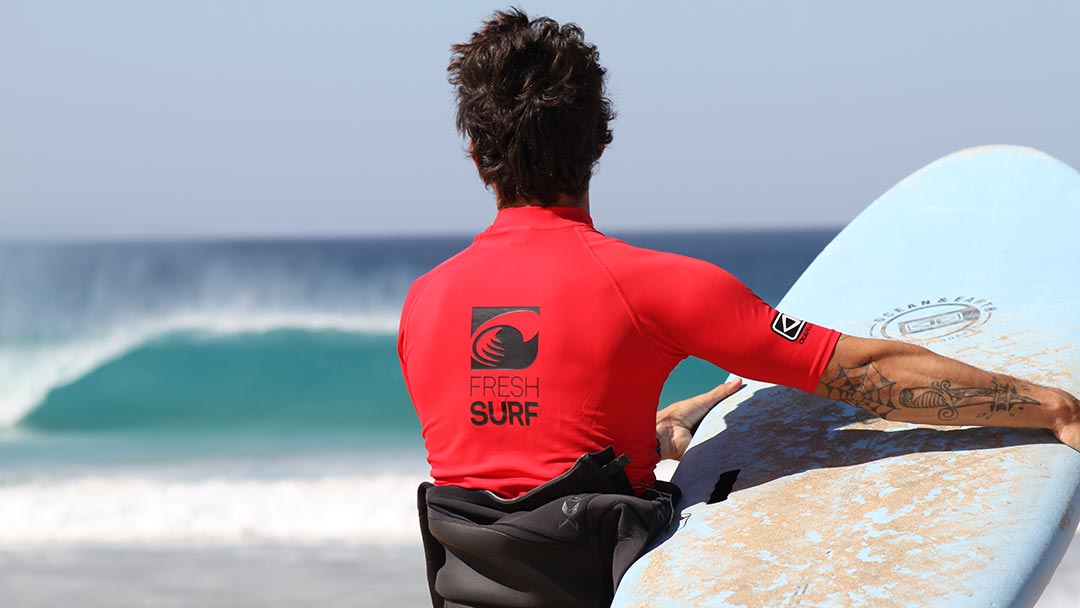
The different characteristics of beaches also have a major influence on the waves. That’s why these are now also explained in more detail in our wave theory.
The beach break – sandy ground
A beach is called a beach break when the waves break over a sandy surface. This has both advantages and disadvantages for surfers. For beginners in particular, the advantage is that if you fall, you only fall on sand. Compared to a surface made of stone or coral, this is not as painful. Another advantage of a beach break is that if you want to get to the beach quickly, you can simply be carried or pushed back to the shore by the white water. A small disadvantage of a beach break is that the sandbanks are always deforming and therefore the waves do not always break at the same point.
The reef break – stony ground
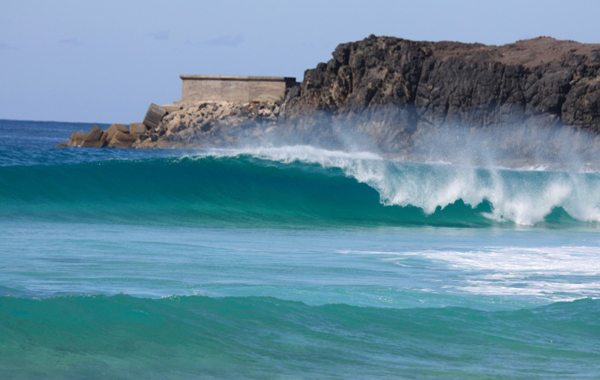
Reef breaks are surf spots where the waves break over reefs. Here, the waves are abruptly slowed down by the reefs emerging from the seabed. As a result, the waves build up extremely quickly and steeply and break very hollow. As reefs cannot be deformed by water energy, the waves break cleanly along the reef at a constant water level and always break at the same point. Unfortunately, the advantage of the very stable ground can also be a small disadvantage for us surfers who are not quite as stable. Reefs consist of either coral or rocks or stones. Always make sure that you go surfing over a reef at the right tide level. At low tide, the bottom may be directly under the surface of the water and you can easily cut yourself on the sharp edges of the reef. If you fall while surfing, you should not push yourself off the ground with your feet after wiping out.
Pointbreak
In connection with the different surfaces, I would like to briefly mention the point break, i.e. a wave that always breaks at a certain point. A point break is a wave that peels along a headland. Points can be found on sandy, rocky or reef bottoms.
The advantage of a point break is as follows: depending on how the headland is shaped, waves can form that are kilometers long. The point of Chicama in Peru is the longest ocean wave in the world with the right swell direction.
The disadvantage of a point break: If you fall on a point break in bigger conditions, you often get stuck dramatically deep in the impact zone. Getting out of there unscathed is not always easy.
And what different types of shaft are there?
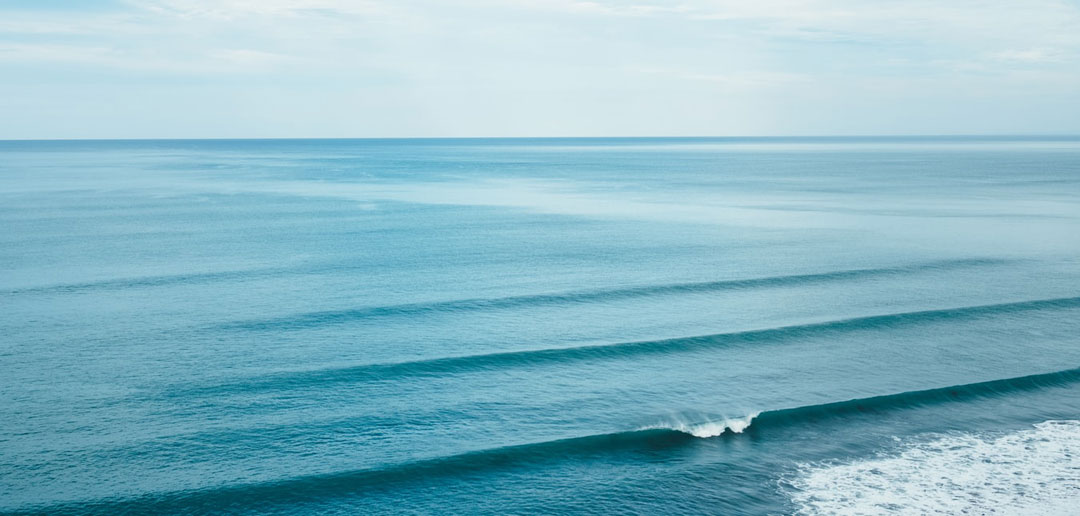
Now you know roughly how waves are created. If you’re already familiar with surfing, you’ve probably heard of green or white waves. If you’re wondering what this actually means, you’ll find the answer here: In addition to the various ways in which or reasons why waves can break, such as the Beach- / reef– or point break there are also different types of waves. Some types are just different phases that a wave goes through and some types can only be created under certain conditions, such as certain wind conditions and the ground. Below we briefly explain the most important different types of waves that you should know.
Green waves
Designate a shaft that has not yet broken. They are the goal of surfingIdeally, a wave is paddled onto and surfed in this state.
White water waves
They earn their name from the color that a wave takes on after it is broken and becomes wave foam. The first steps in the You normally learn to surf in white water. White water rollers usually have a more concentrated power and therefore take you along without much paddling technique. In addition, white water waves are more forgiving of timing and technical errors than green waves and are therefore perfect for practicing.
Shore Break
The shore break mainly occurs when the water level is low, i.e. at low tide at a beach break. A wave builds up until there is hardly any water underneath the wave due to the low water level and the wave breaks directly onto the beach. Surfing the shore break is very difficult and very dangerous! The two most famous shore breaks are probably Waimea Bay in Hawaii and The Wedge at Newport Beach in California.
Barrel
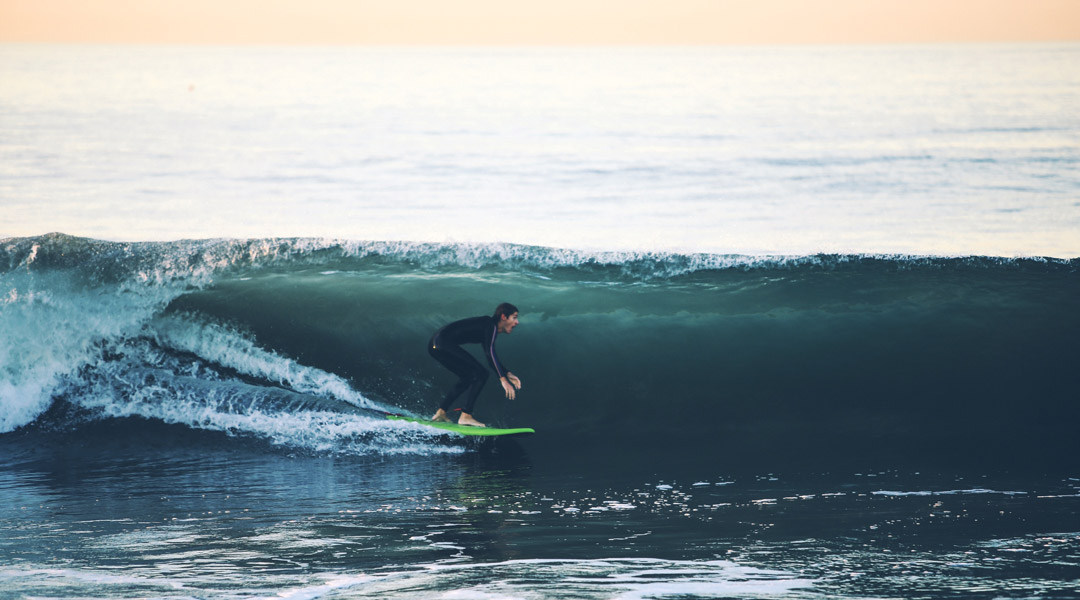
A barrel, also known as a tube, is a hollow wave. It is created when a wave overturns and the lip of a very steep wave breaks onto the surface of the water. This creates a “tunnel” with an opening to one side from which you can ride through at sufficient speed. For many surfers, the barrel or tuberide is the ultimate surfing experience.
Close Out
Refers to a wave that breaks simultaneously along its entire length. If this is the case, it cannot be surfed in any direction.
These are waves that do not move, but are merely created by currents and thus simulate the “face” of a real wave.
There are real standing waves that are created in rivers (sometimes with a little artificial help, of course) and artificial waves. Artificial waves now come in many different forms and make surfing in the city possible. However, they also attract a lot of criticism. Probably the best-known river spot is the Eisbach wave in Munich, Germany.

The flow factor in wave formation and the topic of wave science
Why are the world’s oceans always in motion? Currents are responsible for this. They can also cause waves. This is why the theory of currents is a very important topic in wave science. Currents are only interesting for surfers when they are close to the coast. If you are familiar with the local currents, you can use them effectively.
Currents are an issue in almost every surf session. This is actually obvious, because where water is thrown against a coast in the form of waves, this water has to be led away from the coast again shortly afterwards. This water is the current that can make a surf session hell, but sometimes it can also be an advantage. Because if you’re lucky, you can use it as a kind of elevator back to the lineup. The waves themselves use the energy of the current to push water onto the land. The water pushed onto the land is then pulled back into the sea. The water always seeks the path of least resistance. This can be between sandbanks, at the end of bays or in deeper channels.
As a surfer, you should always remember that there are currents when you paddle out to a spot. These can be more or less intense – but never forget this! You should also make sure that you don’t paddle out directly at the breaking part of the wave – directly in the white water – but use one of the so-called channels just mentioned. Channels can be recognized by the fact that the water there is more turbulent and almost no waves break there. Channels are currents that run backwards and, as described above, bring the water that has been pushed onto land back into the sea.
If you get stuck in a current, with or without a surfboard, don’t try to paddle against the current. You will only waste your energy! Once you are caught by a current that is not pulling you towards the rocks or any other danger, you should stay relaxed and see where you are being pushed and how fast. A current is usually not much wider than ten or 20 meters. If you want to paddle out of a current, you should never swim or paddle directly against it. Instead, try to escape from the current at as right an angle as possible. Try to orientate yourself towards the white water, as this is the place you want to get to in order to get back to the beach quickly. So try to paddle parallel to the beach. After just a few meters, you will notice that the current is weakening until you are completely out of the current shortly afterwards. Now you can paddle towards the beach and rest.
An important tip
You will always find a current where waves break. If the waves are large, you can also expect a strong current. However, you don’t usually have to expect strong currents behind the waves. Sometimes, however, they do exist. An important current that runs parallel to the coast is the so-called lateral current (also known as the longitudinal coastal current). If you are caught by this, you will be swept to the left or right, depending on the direction of the current. You will quickly drift in one direction or the other and may not even notice it. Therefore, look for reference points on land so that you can follow the movement. This could be a mountain, a palm tree or another fixed object. However, it’s better not to choose the nice young woman sunbathing in a skimpy bikini under a parasol while walking into the water. This is because she can quickly move with her parasol and your reference point would change.
Safety in the water - Beach Safety
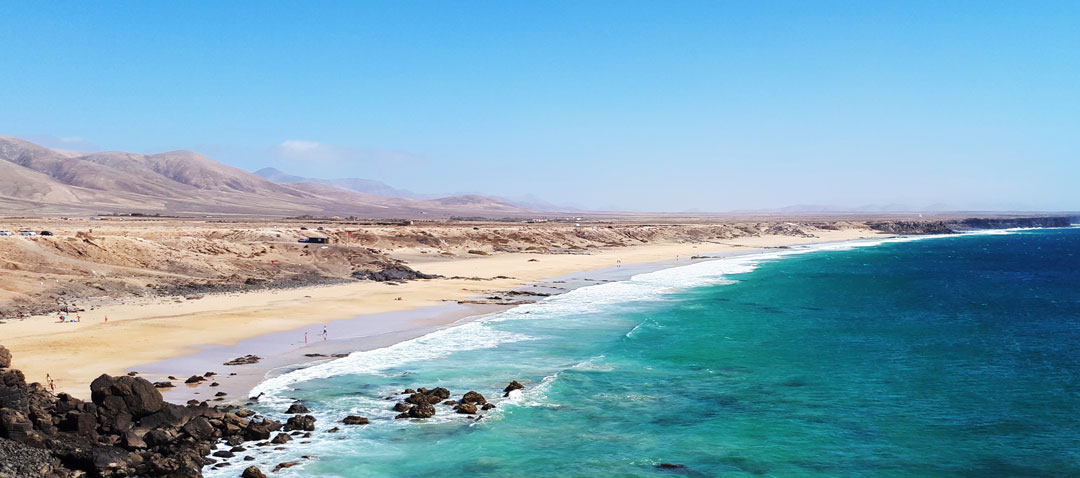
Important things to look out for before you go to the beach or on your day at the beach include lifeguard warning flags, the weather forecast, currents, waves, animals, food and drink and sunscreen. Find out more here!
A few terms on the subject of wave generation briefly explained
Swell
In surfing language, swell means nothing more than swell, i.e. simply put, waves caused by a storm that are disordered and then become more and more orderly. As smaller waves travel slower than large waves and therefore have a lower frequency, they are often caught up by larger waves with a higher frequency and combined into an even larger wave. The forces of the individual waves also complement each other. The longer the swell can run without being slowed down by an obstacle, the more powerful and energized the waves become. And when things go perfectly, all the waves are the same size and when they break they are perfect for surfing.
For many surf spots, it is crucial which direction the swell is coming from. You can find more information about the individual spots and the desired swell directions here:
Surf spots on Fuerteventura
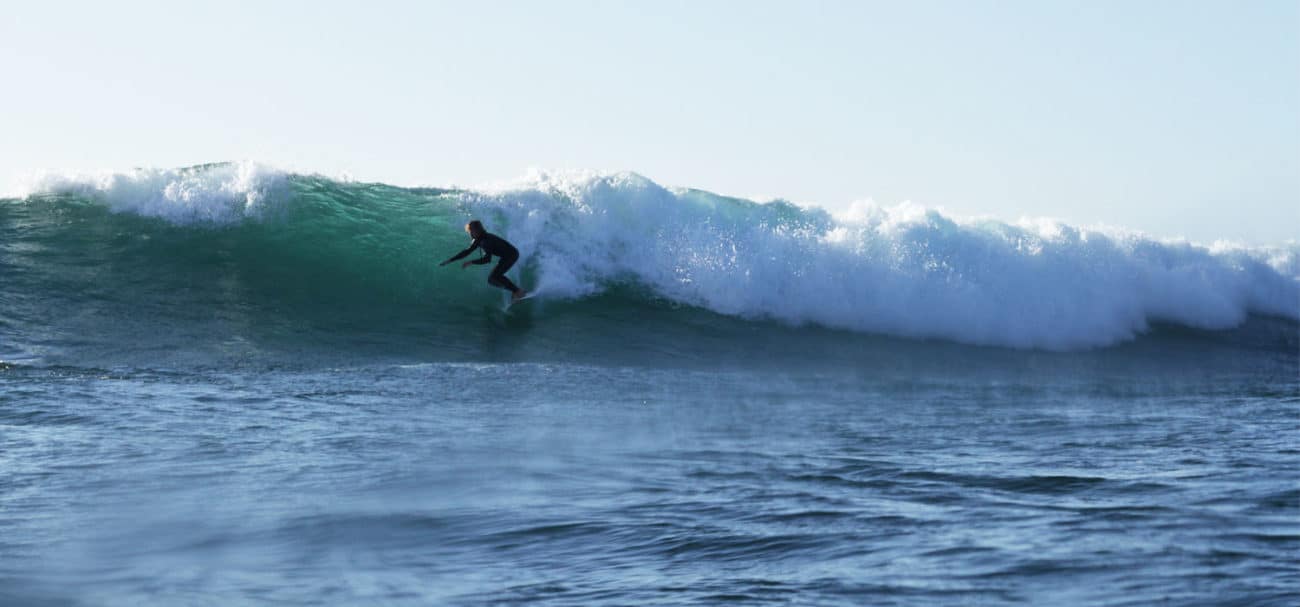
Find out which surf spots need which swell direction and which tides work best here!
Sets
As the swell travels, the waves organize themselves into wave groups. The swell then reaches the coast in these wave groups, the so-called sets. Such sets usually consist of three to seven waves that are roughly the same size and have roughly the same power. These then hit the beach or the reef at an even distance from each other. There are so-called set breaks (periods) between the individual sets. The greater the distance between the waves in a set, the longer the period. The first and last waves of a set are usually slightly smaller than the middle waves. As a beginner surfer, you should therefore make sure that you don’t necessarily take the first wave of a set. If you don’t get it, you may end up hitting the other waves in the set on the head and getting washed out.
Surf
Surf is the term used to describe swell waves when they hit shallow coastal waters and break either over sandbanks or a reef. You can remember the following: the higher the swell, the stronger the surf. The surf can change entire sections of coastline, can shift sandbanks and wash up new sections of beach or wash them into the sea.
Even more surfing knowledge: Everything you need to know about surfing

Surfing tips for beginners

Surf theory
Theory & History

Nutrition & Fitness
recipes & Workouts

Surfing worldwide
Surftrips & Travel information