




4 Tips to Improve Your Paddling Power for Surfing
Build paddling power with strength, balance and endurance exercises and a weekly plan for your next surf session.
Find the right exerciseTo build paddling power, start with what happens on the board. You’re lying on your board, a clean wave is coming and you start paddling. Your arms are working hard, but the wave rolls right underneath you. You’re still trying to pick up speed while the next surfer is already on their feet.
Sound familiar? Building paddling power can help you get out to the line-up more easily and leave you with more energy for the waves. A strong, efficient stroke also helps you build speed when you need it.
You can build paddling power on land as well as in the water. These four training tips give you a simple way to prepare for your next session.
What builds paddling power for surfing?
Paddling power is your ability to drive the board forward and keep doing it over a session. It comes from strength, muscular endurance, core stability and efficient technique.
Next time you practise in El Cotillo, notice how smoothly the board glides during your first few strokes. Move slightly forward or back and compare how much effort it takes to keep the board moving.
Even with strong arms, an awkward position on the board or a late start can cost you speed when you paddle for a wave.
Tip 1 — Build paddling power with strength training
Your back, shoulders and arms do most of the work when you paddle. Your core keeps you steady on the board as you alternate arms.
Start with two focused strength sessions a week to build paddling power. You can do most of these exercises at home.
Strength exercises for paddling
- Pull-ups. Strengthen your back. Assisted pull-ups are a good option if you’re building up to full reps.
- Resistance-band rows. Work your back and shoulders and are easy to do at home.
- Push-ups. Strengthen your chest, shoulders and arms and help with your take-off.
- Planks. Build core stability and help you lie more steadily on the board.

Your at-home mini workout
3 exercises · 2 rounds
- Resistance-band rows
- 10–12 reps
- Push-ups
- 6–12 reps
- Plank
- 20–40 seconds
Rest for 60–90 seconds between sets. Pick a level of resistance that lets you complete every rep with control.
If regular push-ups are too hard, put your hands on a stable raised surface such as a bench.
Our tip. Prioritise good form when you choose a weight. Surfing already puts plenty of demand on your shoulders.
Tip 2 — Improve core stability and balance
Does your surfboard rock from side to side with every stroke? Some of your energy goes into steadying yourself.
A stable core helps you stay centred on the board so you can concentrate on your stroke.
Try these three exercises.
- Side planks. Hold the side plank for 20–30 seconds on each side.
- Bird dogs. On all fours, extend one arm and the opposite leg, then switch sides.
- Single-leg balance. Stand on each leg for 30 seconds and keep your upper body steady.
Start by adding five to ten minutes of balance work to a strength session.
Find your paddling position on the surfboard
Where you lie affects how easily the board glides and how much of your paddling power goes into moving it forward.
Check three things on your next surf.
- Lie along the centre of the board and keep it from rolling side to side.
- Lift your chest slightly and keep your lower back comfortable.
- Slide along the board until the nose sits just clear of the water.
 Balanced positionThe nose sits just above the waterline.
- Too far forwardThe nose digs into the water.
- Too far backThe nose points noticeably upwards.
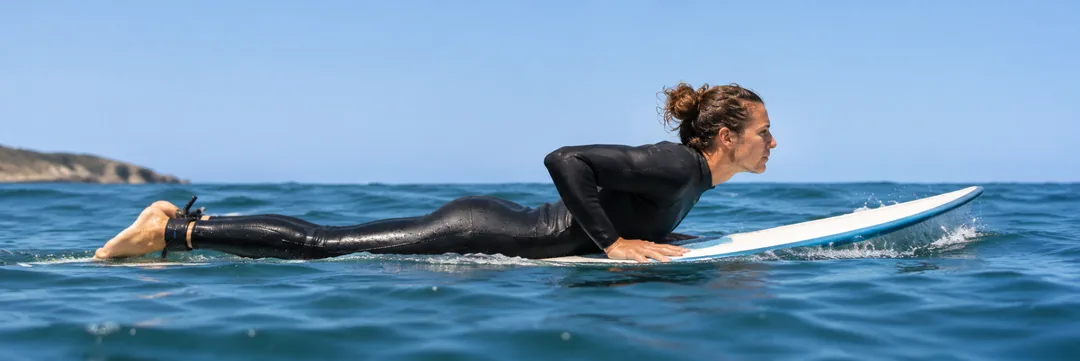 Balanced position
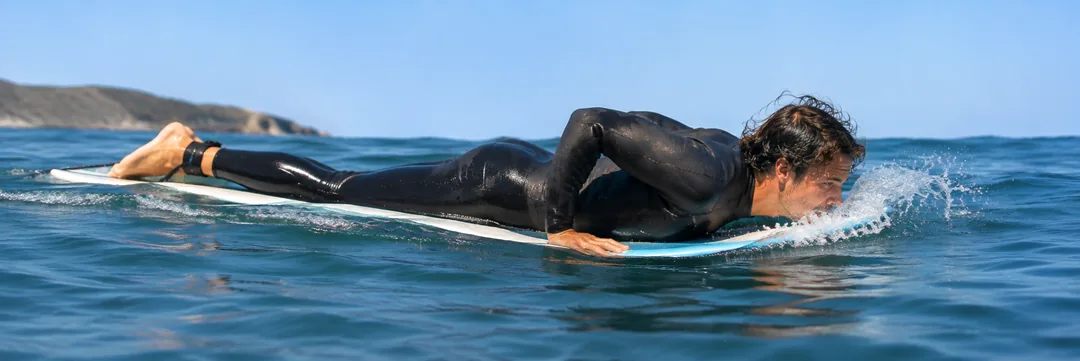 Too far forward
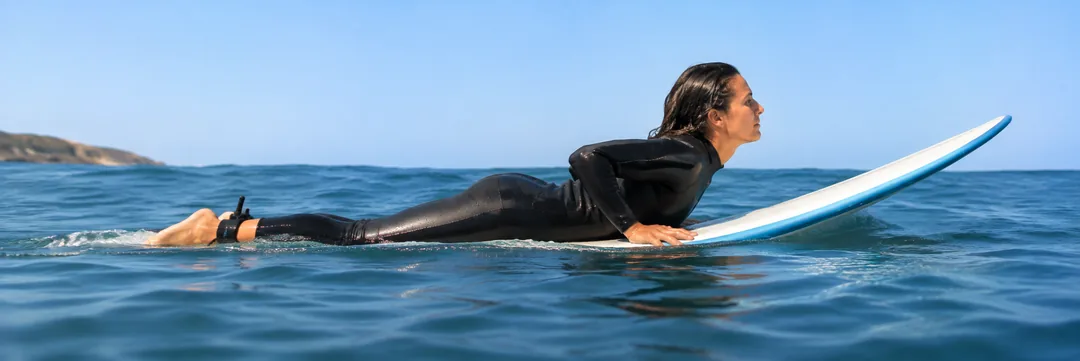 Too far back
Test the three positions in calm water and change one thing at a time. If the nose keeps dipping while you paddle, move back a little. If it rides high and the board feels slow, slide forward and test again. Aim for a board that glides without having to use all your paddling power on every stroke.
Tip 3 — Build paddling endurance by swimming
If your arms feel heavy after only a few minutes, swimming can be a useful addition to your training.
Front crawl works your back and shoulders and builds endurance. It uses alternating arm movements similar to those you use when paddling a surfboard.

A simple pool session
If you’re comfortable swimming front crawl, try this session.
- 5 minutes. Swim at an easy pace to warm up.
- 4 × 50 metres. Swim front crawl at a steady pace.
- 30–60 seconds. Rest after each length or effort.
- 5 minutes. Swim gently to cool down.
If 50 metres feels too demanding, start with 25 metres and build up gradually.
Keep each stroke smooth and use a pace you can maintain.
Good to know. Swimming builds endurance. Practise paddling on your surfboard as well, since the body position and stroke are different.
Tip 4 — Build endurance with interval training
A surf session constantly changes pace. You paddle out at an easy pace, speed up for a wave and then paddle back out.
Intervals train that change of pace. Try them while swimming, using a rowing machine, cycling or running.
Your 15-minute interval session
15 minutes- 5-minute warm-up
- Easy pace
- 5 × 30 seconds at a brisk pace
- Follow each effort with 60 seconds at an easy pace
- 2:30-minute cool-down
- Gradually ease off
The fast efforts should feel demanding. Keep each one under control.
One interval session a week is a good starting point. Make time for recovery, especially if you already surf regularly.
Which training should you start with?
Work out whether paddling power, endurance or technique is holding you back most often.
| What you notice | What to work on |
|---|---|
| Your arms tire quickly. | Front crawl and muscular endurance |
| You struggle to accelerate into a wave. | Back and shoulder strength |
| You’re worn out after a few waves. | Endurance and intervals |
| Your board rocks as you paddle. | Core stability and board position |
| You paddle hard and still miss waves. | Paddling technique, positioning and timing |
If you keep missing waves, check when you start paddling and where you lie on the board. That can tell you whether there’s a technique change to make before increasing your training load.
A simple weekly plan for more paddling power
If you’re ready to start and have limited time, try spreading your training out like this.
| Day | Training | Duration |
|---|---|---|
| Monday | Back, shoulders and core | 20–30 min |
| Wednesday | Swimming | 20–30 min |
| Friday | Strength and balance | 20–30 min |
| Sunday | Intervals | 15 min |
Use this plan to build paddling power if you’re new to surf training and have a basic level of fitness. If you surf regularly, you may need fewer extra sessions.
Build up the workload gradually and give yourself time to recover. Pause if you develop shoulder or back pain, and get persistent symptoms checked by a qualified professional.
Look for other signs of progress alongside wave count. You might paddle for longer, recover faster or feel steadier on the board.
FAQs about paddling power for surfing
Which muscles should I train for surfing?
Focus on your back, shoulders, arms and core. Pull-ups, rows, push-ups and planks are good exercises for improving paddling power.
How often should I train for paddling?
Two focused strength sessions a week are a good starting point. Add swimming or other endurance work if it fits your schedule. If you already surf regularly, adjust the extra training to match.
Does swimming help with paddling on a surfboard?
Yes. Front crawl builds endurance and works many of the muscles you use to paddle. Practise on your surfboard to work on the specific paddling technique.
Why do I miss waves even when I paddle hard?
Your position on the board, when you start paddling and the efficiency of your stroke all affect whether you catch a wave. Check those three things alongside your strength.
Can I improve my paddling power at home?
Yes. Resistance-band rows, push-ups, planks and other bodyweight exercises train your back, shoulders and core at home.
More paddling power, more energy for your waves
Regular strength sessions, swimming and short intervals can give you more paddling power for longer sessions. A simple routine is enough to get started.
If time is short, begin with two strength sessions a week and add endurance work gradually.
Apply that strength on the board by practising your technique and timing.
The aim is to save enough energy for the part of the session you came for: riding waves.
Ready to put your paddling into practice?

Surf camp in Fuerteventura
Spend a week surfing, practising and enjoying the sea in El Cotillo.
Explore the surf camp
Surf taster lesson
Give surfing a go in a small group. Equipment is included, €60 per session.
Explore the taster lesson