



Surfing on standing waves has become more and more popular in recent years – more standing waves are being planned all over Germany. But there are also a few standing waves elsewhere in the world. For example, the “European Championship of Stationary Wave Riding” takes place once a year at Munich Airport, and Jochen Schweizer has also brought his adventure arena with a standing wave (with tropical water temperatures) to the Munich area.
So Mick Fanning, Jack Freestone &Co thought: why not jump into the river for another surf? All of this, of course, after a visit to the Jochen Schweizer Arena and before heading to Oktoberfest. By now it’s looking really good for the three-time world champion and his boys!
Eisbach
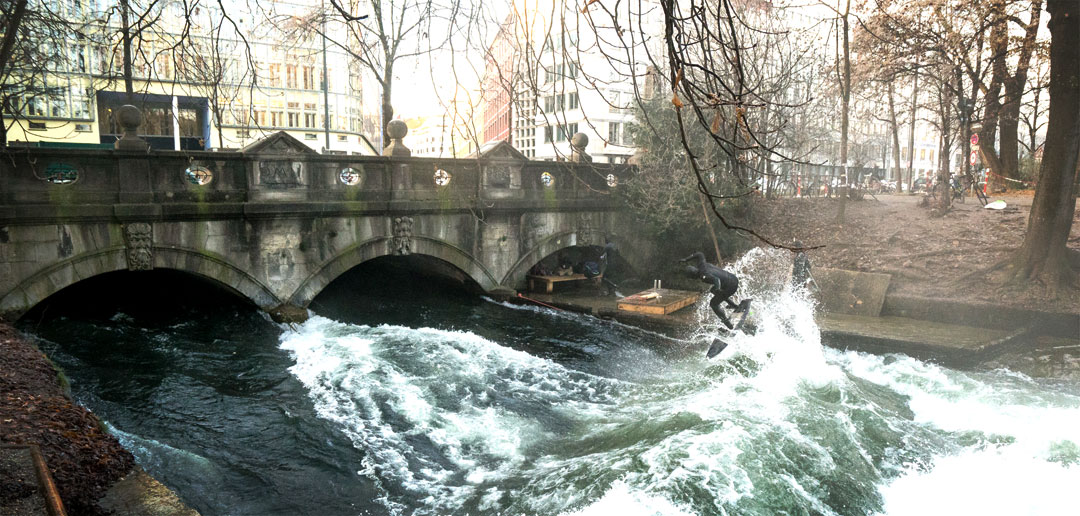
Probably the best-known river wave is the Eisbach wave. Surfers, pro surfers and spectators from all over the world are drawn to the wave on Prinzregentenstraße in the middle of Munich. And yet surfing there hasn’t been allowed for all that long! Because of the many accidents at the Eisbach – especially involving inexperienced surfers – the authority in charge wanted to close the wave.
Thanks to a group of dedicated Munich surfers, the Eisbach wave was saved in 2007. This was also the starting point for the later founding of the association IGSM – Interessensgemeinschaft Surfen in München (Munich surfing interest group), which campaigns for building and preserving all waves in and around Munich. Since then, surfing on the Eisbach wave has been allowed for experienced surfers. The documentary Keep Surfing by Björn Richie Lob also helped preserve the wave. The Eisbach and Eisbach surfing have almost become a trademark of the city of Munich.
However, the Eisbach wave is definitely not a beginner wave and is therefore not suitable for your first attempts at standing up on a surfboard. What looks super easy for the guys around Lukas, Tao & co. (and probably is for them) is more than dangerous for beginners. The extremely strong current and the rows of concrete blocks behind the wave pose an enormous risk of injury for inexperienced surfers.
So if you fancy trying river surfing in Munich and aren’t that experienced yet, you can head to the lovely Floßlände – it’s open from May to October and ideal for beginners. There’s also the small Eisbach wave, which is also in the English Garden. Here, too, surfing is only tolerated, not officially permitted – so it’s at your own risk. But just like at any other spot, there are surfing rules here that absolutely must be followed in the interest of all surfers.
Fancy surfing in the ocean?


 1 week from


Ein weiterer Unterschied beim Surfen auf stehenden Wellen ist die Wahl der Surfbretter. Während Anfänger im Meer meist auf großen Softboards surfen, geht es beim Riversurfen deutlich kleiner zu. Eine wichtige Rolle bei der Wahl des Surfbretts spielt auch die Welle selbst (zusätzlich zu Größe und Gewicht des Surfers natürlich). Für die Floßlände eignen sich auch kürzere Bretter mit weniger Volumen, während der Druck der E2 eher voluminösere Surfboards verlangt.
Hier wurden speziell Bretter für die verschiedenen Eigenschaften der Wellen entwickelt. Buster Surfboards geben bei ihren Brettern zum Beispiel genaue Angaben zum Druck der Welle und Gewicht der Surfer. Auch Light, Fatum, Mighty Otter und viele weitere lokale Shaper haben sich auf die Riverboards spezialisiert. So beginnt man das Surfen im Fluss eher mit einem 5’10er Buster Surfboard als mit einem 8’0er Foamie. Ein kleiner Tipp an alle Flusssurfer ohne Meer-Erfahrung: Lasst euer Shortboard zu Hause, wenn ihr ans Meer fahrt und holt euch ein gemütliches Softtop oder Minimalibu zum Anfangen – denn Fluss ist nicht gleich Meer!
Here Arthur Pauli looks back on the origins of river surfing in Munich
1: Noah von Thun