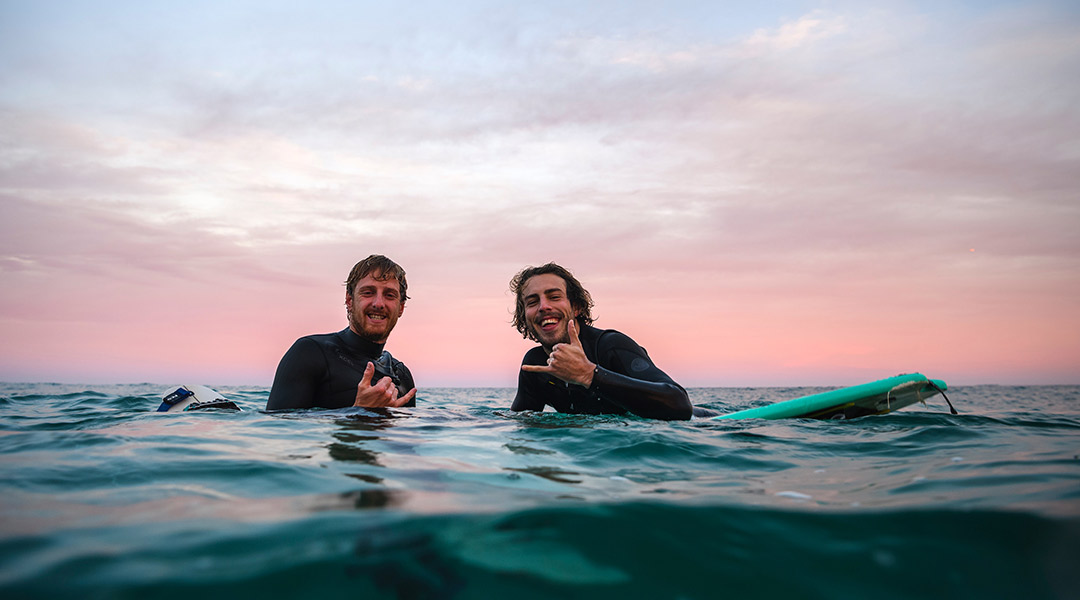
Fuerteventura is a great place to learn to surf. What matters most isn’t so much finding the “perfect” beginner’s beach or the supposedly “best” time of year. To catch your first waves , the surf spot, the waves, the wind, the tide, and your skill level all need to align.
If you’re not yet able to assess these factors on your own, a beginner’s course is the easiest way to get started. You can focus on paddling, take-offs, board control, and catching your first waves, while the spot and conditions are chosen to match your skill level.
Is Fuerteventura suitable for beginner surfers?
Yes. Thanks to the variety of coastlines and surf spots, there are always plenty of opportunities to find suitable conditions for learning on Fuerteventura.
You don’t need spectacular waves for your first few sessions. Conditions that allow you to make plenty of controlled attempts are more helpful:

- manageable waves
- a suitable entry and exit point
- as little problematic current as possible
- enough space between you and other surfers
- Conditions in which you feel safe
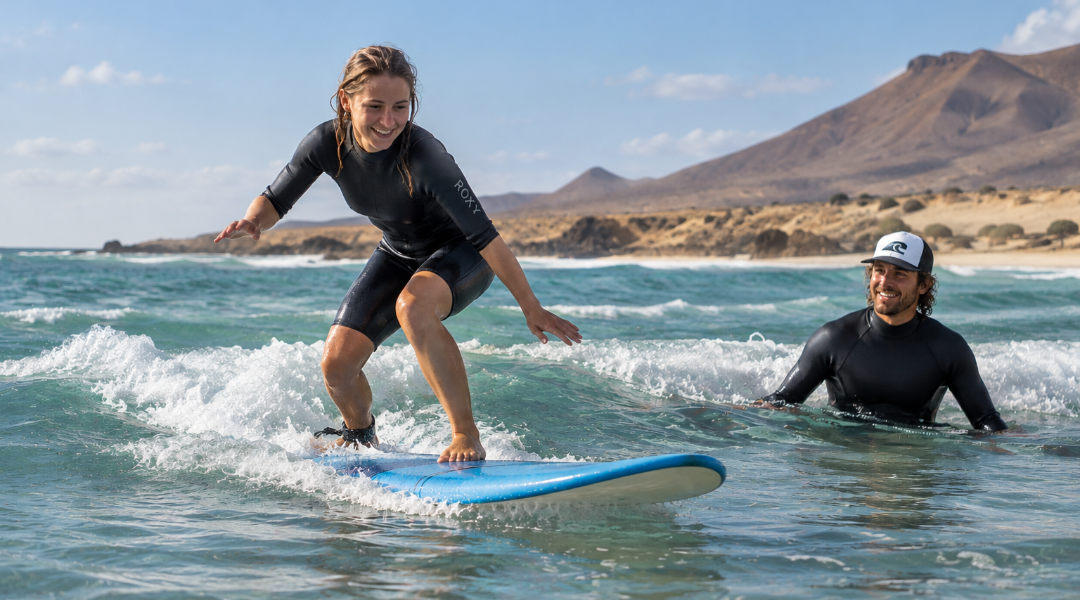
At first, it’s mostly about repeating the steps: paddling, feeling the wave, standing up, finding your balance.
And at some point, everything clicks. The board picks up speed, you’re standing, and you ride your first few meters. The wave might last only a few seconds. The grin usually lasts longer.

Which surf spots on Fuerteventura are suitable for beginners?
There are beginner-friendly surf spots—but there isn’t a single surf spot that’s beginner-friendly every day.
On Fuerteventura, spots like Punta Blanca, Playa del Morro, and—to name an ideal beach for beginners— Playa de La Concha in El Cotillo are used for surfing. Thanks to gentle waves and clear water, you’ll find excellent conditions for learning here. However, whether one of these spots is right for you can’t be determined solely by its name or the seabed.
It’s also too simplistic to assume that “sandy beach = beginner’s beach.” A sandy bottom can be pleasant, but it says little about wave size, currents, or how easy it is to get in and out of the water.

Here’s what you should look for when choosing a spot
Waves: Are the size and power manageable for you?
Current: Can you tell where the water is carrying you?
Wind: How does it affect the waves at this spot?
Tide: How do high and low tides affect the water level and the breaking waves?
Getting in and out: Do you know where you can safely get in and out?
Crowded conditions: Is there enough space between you and other surfers?
If you can’t yet reliably assess these points, get a local’s opinion or go in the water with a surf coach.
For a more detailed overview, check out the FreshSurf guide to surf spots on Fuerteventura.

When is the best time of year for beginners to go surfing in Fuerteventura?
The rule of thumb “summer for beginners, winter for advanced surfers” is only a rough guide.
During the summer months, there may be periods of smaller waves, while between fall and spring, stronger swells tend to roll in more frequently. However, this doesn’t mean that summer is automatically easy and winter is automatically too difficult.
So, if you’re taking a surf course, you don’t have to plan your vacation exclusively around what’s supposedly the perfect season for beginners. If, on the other hand, you want to surf on your own, you should be able to reliably assess the forecast and local conditions.

What do you learn in a beginner’s surfing class?
If you’ve never surfed before or have very little experience, you’ll start by learning the basics:

- Paddling and Position on the Board
- Takeoff and stable starting position
- Recognizing suitable waves
- Board control
- Safety and Behavior in the Water
At FreshSurf, the choice of surf spot depends on the conditions and the group’s skill level. This takes an important decision off your hands, especially for beginners: You don’t have to figure out for yourself where it makes sense to go in the water that day.
One session or several days of surfing?

If you just want to give surfing a try, a single session can be a good place to start.
If you want to solidify your basics, booking multiple days of surfing makes more sense. You’ll get more practice and can apply feedback from one session directly to the next.
You can find the current offerings, course options, and prices directly at the FreshSurf Surf Course for Beginners.

What gear do you need to learn to surf?
You don’t need a small, sporty surfboard for your first waves. You need a board that lets you make as many meaningful attempts as possible.
That’s why larger softboards are often used for beginners. Their larger surface area and volume make paddling easier, provide more stability, and help you catch waves sooner.
You can find out exactly what equipment is currently included in your FreshSurf course directly in the respective course description. That way, you’ll know exactly what’s provided and what you should bring yourself before you arrive.

Other items that come in handy for a day of surfing:
- Swimwear
- Sunscreen
- Towel or poncho
- Dry clothes
- something to drink
Having your own surfboard becomes more appealing as you start surfing on your own more often and get a better sense of which size and type of board suit you best.
You can find more information in the FreshSurf overview of surfboard types and models.
Safety: When Should You Avoid Going Into the Water Alone?
As a beginner surfer in Fuerteventura, you don’t have to be able to read the ocean perfectly yet. However, you should be able to recognize when you lack the experience to make a safe decision.

Before you go into the water—ask yourself the following questions
- Is the wave size appropriate for my skill level?
- Do I know a safe way to get in and out of the water?
- Can I assess currents and other hazards?
- Am I familiar with the seabed and the specific characteristics of the spot?
- Is there enough space in the water?
- Do I know the most important surfing rules and right-of-way rules?
- Is my equipment in good condition and suitable for my skill level?
- Do I really feel safe in these conditions?
If you can’t answer several of these questions, get a local’s opinion or head out into the water with a surf coach.
The ocean isn’t going anywhere. There will be waves again tomorrow.

How to Plan Your First Days of Surfing
You don’t need a complicated plan for your first surfing vacation:
- Get some guidance when you’re new to this. That way, you won’t have to assess the spot and conditions on your own just yet.
- Schedule several sessions if you really want to learn. Repetition helps you solidify movement patterns.
- Focus on the basics. Paddling, take-offs, and board control will get you further at first than bigger waves.
- Watch the ocean. Feel free to ask your coach why the conditions are just right today—that way, you’ll not only learn to surf, but also gradually come to understand the ocean better.
- Take it step by step. More challenging conditions don’t automatically mean more progress.
So the better question for your first days of surfing isn’t:“Where are the best waves?”
But rather:
“Where can I learn safely and effectively today?”
Frequently Asked Questions About Surfing in Fuerteventura for Beginners
Can I learn to surf at FreshSurf if I've never stood on a board before?
Yes. The beginner’s course is designed for people with little or no surfing experience and starts with the basics.
Which surf spot on Fuerteventura is best for beginners?
You can’t really pin that down to a single spot. A spot that’s generally beginner-friendly can become significantly more challenging under different wave, wind, or tide conditions.
Is summer the best time to learn to surf?
Not necessarily. In the summer, there may be periods of smaller waves, but suitable conditions for beginners can also arise during other seasons.
How much does a surf lesson cost at FreshSurf?
You can find the current prices and course options directly on the FreshSurf beginner’s surf course page.
Is a single surf session enough?
One session might be enough to give it a try. If you want to build a solid foundation, spending several days surfing will help because you’ll get more practice and can apply the feedback right away.
As a beginner, can I surf on my own?
If you’re not yet confident in assessing waves, currents, spot conditions, and surfing rules, having a professional guide is the better choice. As you gain more experience, you can gradually become more independent.
Your First Waves in Fuerteventura
For your first waves, you don’t need the most famous spot—and certainly not the biggest waves. You need conditions where you can safely focus on the basics. You can find more information about surfing in Fuerte here.
If you’d like some help with this, you can check out the current courses, services, and prices for the FreshSurf beginner’s surf course on Fuerteventura.

And then, at some point, it all comes down to that one moment: The board picks up speed, you rise up—and you’re riding.