
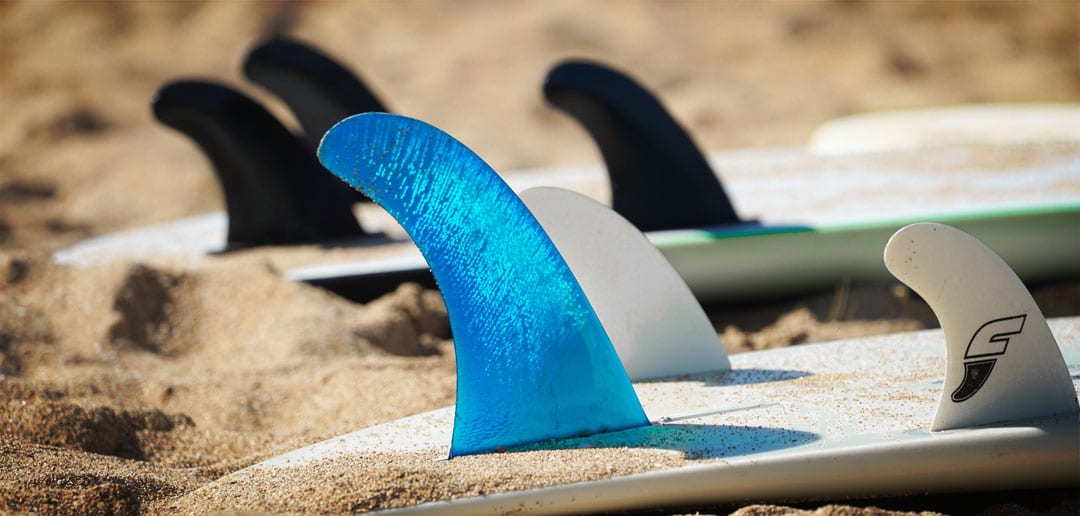
The fins on the underside of a surfboard aren’t just for show; they determine how the board behaves when riding a wave. However, not all fins are the same: the issue of size, placement, configuration, and so on is actually a bit more complex than it seems. So here’s the most important information about surfboard fins:
Size:
Fins are usually available in sizes XS, S, M, L and XL, which depend on body weight. Unless the manufacturer has its own sizing system, the following sizes generally apply:
XS:> 55 kg // S: 55–70 kg // M: 65–80 kg // L: 75–90 kg // XL: < 85 kg
Material:
Beginner surfboards usually have moulded plastic fins. The standard models are relatively inexpensive and, in most cases, perfectly adequate. Slightly more experienced surfers who want to get the most out of their fins often opt for fibreglass or carbon fins. However, lighter models with a foam core and carbon shell are also available.
Fin systems:
Generally speaking, there are quite a few different fin systems on the market. The four most common systems are as follows:
FCS I: This fin system is probably the most common system for the classic 2-tab fin, i.e. a fin with two small tabs at the base. With this system, there are two fin plugs on the surfboard into which the fin’s tabs are inserted and then secured using a fin key (Finkey) and small screws.
FCS II: With this fin system, a snap-in mechanism ensures that the fins can be attached to the board without screws. Special FCS II fins are available for this purpose. However, FCS I fins with two tabs can also be attached using a screw.
Futures: Just like with the FCS I system, the fins are attached to the board using a screw. However, as this fin system is not very common in Europe, it may be a little more difficult to find replacements if a fin does happen to get lost or broken.
US Fin Box: This fin system is specifically designed for single fins and allows the fin to be positioned in various ways. The fin sits in a rail along which it can be moved forwards or backwards as required, and is then secured in the desired position with a screw.
Fin Set-Ups:
As you’ve no doubt seen before, there are surfboards with one fin (single fin), two fins (twin fin), three fins (thruster fin), four fins (quad fin), five fins (bonzer) or none at all (alaia). Especially when you’re just starting out, you’ll usually surf on a board with three fins. However, the better you get, the more the other set-ups may come into their own.